

How Progressive Jackpots Are Really Funded (And Who Pays for the Millionaire)
How Progressive Jackpots Are Really Funded (And Who Pays for the Millionaire)
A progressive jackpot can show £12 million on screen, climbing in real time, and the obvious question is the one almost nobody answers properly: where does that money actually come from? Not the casino’s marketing budget. Not the game studio’s pocket. It comes from players — specifically, from a tiny slice carved out of every single spin, by thousands of people, across dozens of casinos, for weeks or months on end, until one of them wins the lot.
That’s the whole trick, and once you see the mechanics you understand things that look like mysteries from the outside: why a progressive slot’s base game feels stingier than a normal one, why the jackpot resets to millions rather than zero, why some prizes “must drop” by a deadline, and why the person who eventually scoops it is, in a real sense, being paid by everyone who span before them. Here’s how the engine actually works.
The Two Numbers That Build Every Jackpot
Every progressive runs on two figures: the seed and the contribution.
The seed is the guaranteed minimum the jackpot resets to the instant it’s won. It’s funded by the game provider, not the players, and it’s why a freshly won jackpot doesn’t drop to zero — it springs straight back to an attractive headline number. The famous wide-area networks seed high to stay tempting: the Mega Moolah and WowPot mega tiers reset at around £2 million, so even a “fresh” jackpot is already life-changing. The seed is a marketing cost the provider swallows to keep the game compelling.
The contribution is where the players come in. A small percentage of every real-money wager — typically somewhere between 1% and 5% — is siphoned off the top and funnelled into the prize pool. It’s not added to your bet; it’s carved out of it. That slice does nothing for your spin on the reels. It goes straight into the pot, building it, penny by penny, until someone triggers the win.
So the jackpot you see is the provider’s seed plus everybody’s accumulated contributions since the last win. The seed primes the pump; the players fill the bucket.
Follow a £1 Spin
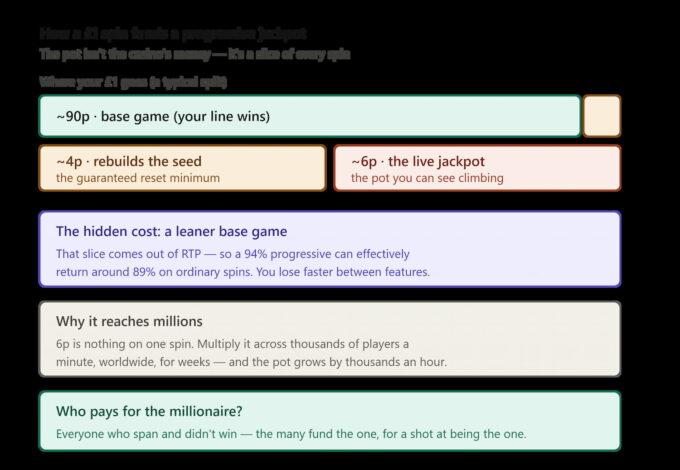
Make it concrete. Spin £1 on a typical progressive and the pound splits roughly like this: around 90p goes into the base game’s return-to-player — the pool that pays your ordinary line wins — while the remaining 10p or so is divided between topping up the next seed and feeding the current jackpot. The exact split varies by game, but a realistic shape is something like 4p toward rebuilding the seed and 6p into the live progressive pot.
Six pence sounds trivial. It is, on one spin. But a single popular wide-area progressive might take contributions from hundreds of players a minute across dozens of casinos worldwide, around the clock, across time zones. At that volume the pot swells by thousands of pounds an hour — which is exactly how a jackpot climbs into eight figures between wins, and why peak-traffic evenings grow it fastest. Multiply 6p by millions of daily spins and the millionaire-maker funds itself.
The Hidden Cost: a Leaner Base Game
Here’s the part that matters most to you as a player, and it follows directly from the funding model. That contribution doesn’t appear from nowhere — it’s taken out of the game’s overall return-to-player. So a progressive slot almost always has a lower base-game RTP than an equivalent fixed-prize slot, because a chunk of the theoretical return has been diverted into a jackpot you will almost certainly never win.
The arithmetic is stark. If a progressive advertises 94% RTP and roughly 5% of that is being routed to the jackpot, the base game is effectively returning closer to 89% on ordinary spins. You’ll feel it: thinner, less frequent line wins, swingier sessions, a balance that drains faster between features than it would on a high-RTP standard slot. This is the genuine trade-off, and it’s the inverse of the deal we described in how the UK redesigned online slots: you accept a colder base game in exchange for a lottery-sized long shot. That’s not a flaw in the design. It is the design. The jackpot is funded by quietly making every normal spin pay a little less.
Many of these live game shows headline the best live dealer casinos, where Evolution’s Lightning and game-show tables run alongside the classics
Why Network Size Decides Everything
Not all progressives are equal, and the difference comes down to how many players share the pot.
A standalone progressive is confined to a single machine or a single game at one casino. Only that site’s players feed it, so it grows slowly and tops out modestly — think thousands, not millions.
A local (or linked) progressive pools wagers across multiple games within one casino group or operator. More players, bigger pot, still contained within one brand’s walls.
A wide-area network progressive is the millionaire-maker. It links the same game across dozens or hundreds of separate casinos — often across multiple countries — via a central server, so a single pot is fed by a global crowd spinning simultaneously. This shared-liquidity model is the entire reason Mega Moolah, Mega Fortune and WowPot reach headline-making sizes. When you play a wide-area progressive at one casino, you’re contributing to — and competing for — the identical pot as someone playing a differently branded site on another continent. The wider the net, the faster it climbs and the larger it grows before it falls.
It’s also why these games are a favourite engine of the white-label model: the same networked jackpot can be dropped into dozens of platform-built casino brands at once, each presenting it as its own.
Must-Drop and Daily Jackpots: a Different Promise
The classic progressive falls purely at random. A newer breed changes the rules in a way worth understanding, because it changes the maths of when.
Must-drop and daily-drop jackpots come with a built-in deadline or ceiling: the pot is guaranteed to pay out before it reaches a set value, or before a set time — by midnight, say, or before it crosses £3 million. As the pool nears that limit, you get a “frenzy” period where the jackpot is increasingly overdue and players pile in. The Red Tiger daily drops and the Dream Drop series popularised this design.
The honest framing: a must-drop guarantees the timing of a payout, not your odds of being the one to land it. The pot will drop before the deadline — but to one of the many people playing as it climbs, and the more who join the frenzy, the more diluted any individual chance becomes. It’s a genuinely different product from a pure random progressive, with more frequent, generally smaller payouts, but it isn’t a loophole. The house edge is intact either way.
After the Win: the Seed-Recovery Period
There’s a neat economic wrinkle most players never notice. When a big jackpot is won, the provider has to fund that multi-million seed for the next round out of its own pocket. It recovers that outlay over time from the slice of each bet earmarked for seeding — which means, in the period right after a major win, a larger share of contributions is going toward rebuilding the seed the provider just paid out, rather than swelling the live pot.
That’s why a freshly reset jackpot can appear to climb a little more slowly at first, then accelerate once the seed is recouped and more of each contribution flows to the visible pool. The provider isn’t losing money on the millionaire it just created; it’s recovering the seed from the next wave of players. The model is self-financing by design.
How the Jackpot Is Actually Triggered
Two mechanisms decide who wins, and both run on the certified random number generator — the same engine behind every fair slot outcome.
The most common is a random trigger: any spin can fire the jackpot, regardless of the symbols on the reels, often launching a bonus wheel where the pointer decides which tier you win. The alternative is a symbol-combination trigger, where you need a specific set of symbols or scatters on an active line to enter the jackpot round — closer to triggering a normal bonus feature.
Two practical truths sit on top of this. First, on many games the chance of entering the jackpot feature scales with bet size — bigger stakes, better odds of triggering — even though, once you’re in the bonus round, the tier you win is usually pure chance. Some legacy games go further and require a minimum or maximum bet to qualify for the top tier at all, so a small stake can win a Mini but be locked out of the Mega. Always check the game’s eligibility rules before chasing the headline number; the prize you’re picturing may need a stake you weren’t planning to make. Second, no one — not the player, the casino or the provider — can predict or manipulate a random trigger. The odds of the top prize are genuinely lottery-like, in the millions to one.
Who Actually Pays for the Millionaire?
Put the pieces together and the answer is clear, and a little poetic. The provider fronts the seed and recovers it from future play. The casino contributes nothing from its own pocket beyond hosting the game — it simply passes a slice of player wagers up to the network. And the bulk of every record-breaking prize is the accumulated contributions of thousands of players who span and didn’t win, each donating a few pence per spin to a pot that one stranger eventually collected.
That isn’t a criticism. It’s how pooled prizes work everywhere, from the National Lottery to a workplace raffle: the many fund the one, in exchange for a shot at being the one. Understanding it just lets you play with clear eyes — knowing the base game runs colder by design, that the £12 million on screen is everyone’s pennies stacked up, and that your real cost of admission to the dream is a slightly leaner spin every time. For the wider picture of how UK casino games and their economics work, our online casinos hub is the place to start.
FAQs About Progressive Jackpots
Where does the progressive jackpot money come from? From players. A small percentage of every real-money wager — usually 1% to 5% — is carved out and added to the pool, with the game provider funding only the guaranteed minimum “seed” the jackpot resets to.
What is the seed amount? The guaranteed starting value a jackpot resets to after it’s won, funded by the provider so the prize never drops to zero. Big networks like Mega Moolah and WowPot seed their top tier at around £2 million.
Do progressive slots have a lower RTP? Usually, yes — for the base game. Because part of every wager is diverted to the jackpot, the ordinary line-win return is lower than on an equivalent fixed-prize slot, so sessions feel swingier between features.
What’s the difference between standalone, local and network jackpots? Standalone jackpots are fed by one game at one casino and stay small. Local ones pool across a single operator. Wide-area network jackpots link the same game across hundreds of casinos worldwide, which is how they reach millions.
What does “must drop” mean? The jackpot is guaranteed to pay out before a set time or before reaching a set value. It guarantees the timing of a payout, not your personal odds of winning it, and tends to produce more frequent, smaller prizes.
Does betting more improve my chances? On many games, a bigger stake increases the chance of triggering the jackpot feature, and some games require a minimum bet to qualify for the top tier. But once the bonus round starts, the tier you win is typically random. Always check the eligibility rules.
Can the casino or provider control when a jackpot drops? No. Random-trigger jackpots are governed by a certified random number generator, so the timing can’t be predicted or manipulated. Must-drop jackpots are the exception only in that they have a guaranteed deadline, still awarded randomly among players.
Why does a jackpot grow slowly just after it’s been won? Because the provider is recovering the multi-million seed it just funded. In the period after a big win, more of each contribution goes toward rebuilding the seed before the visible pot starts climbing quickly again.
What’s the biggest progressive jackpot ever paid? Mega Moolah set the record with a payout of around €18.9 million to a single player in 2018, and the game has reportedly created dozens of millionaires since its 2006 launch.
Can I play progressives with bonus funds? Often not. Many casinos restrict progressive jackpot slots from bonus play because of how the RTP contribution works, so check the terms — these games are usually best played with real money.
18+. Play responsibly. Gambling can be addictive. For free, confidential support visit BeGambleAware.org or call the National Gambling Helpline on 0808 8020 133. This guide is general information; game mechanics and jackpot rules vary by provider, so check each game’s paytable and terms before playing.
Written by: Jamie Shaw