
Do You Pay Tax on UK Casino Winnings? (And the Professional-Gambler Myth)
Do You Pay Tax on UK Casino Winnings? (And the Professional-Gambler Myth)
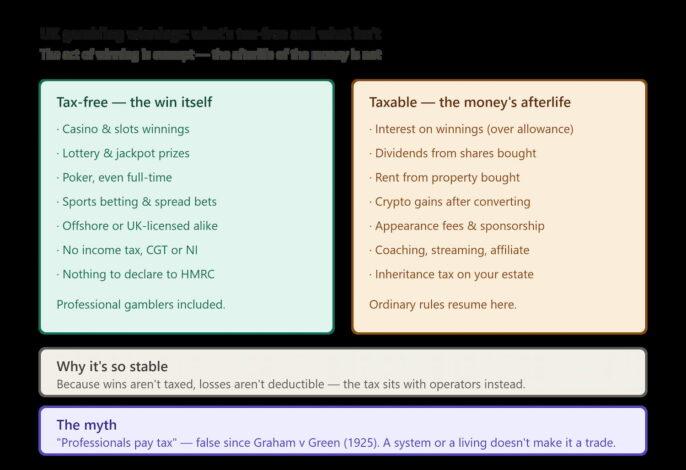
Short answer: no. You hit a £14,000 slot win, a £2 million progressive, or a steady monthly profit from poker, and HMRC takes nothing. Not income tax, not capital gains tax, not National Insurance. You don’t declare it, you don’t ring an accountant, and you don’t owe a penny on the winnings themselves.
That’s the clean version, and for most people it’s the whole story. But the question keeps people awake at night anyway — partly because American films and US-centric advice online have convinced a generation of British players that the taxman wants a cut, and partly because a persistent myth says that professional gamblers, or anyone “systematic” enough, lose the exemption. Neither is true, and the reasons why are genuinely interesting. There are also a couple of real edge cases worth knowing, because they catch out exactly the people who’ve had the biggest wins.
Here’s the complete picture: why winnings are tax-free, why being a professional doesn’t change that, and the narrow situations where a tax bill can appear after the win.
Why Your Winnings Are Tax-Free
UK tax law only bites on income from an identifiable source — employment, a trade, rental property, savings interest, dividends. Gambling winnings don’t fit any of those boxes. A bet is treated as a recreational wager, not earned income and not the disposal of an asset, so it falls outside income tax and outside capital gains tax simultaneously. A specific line of statute even confirms it: winnings from betting are not chargeable gains for CGT purposes. No source, no charge.
There’s a deeper logic, too, and it’s worth understanding because it explains why the rule is so stable. The UK runs on a principle of symmetry. Because gambling losses are not tax-deductible, it follows that winnings can’t be taxable — the two have to move together. If HMRC taxed your £1,000 win on Saturday, it would, in fairness, have to let you deduct your £1,000 loss on Sunday. It has absolutely no interest in subsidising the nation’s losing bets, so it does neither. Wins aren’t taxed; losses aren’t relieved. The exemption is a package deal.
Where the Tax Actually Goes: the Operator
The money doesn’t escape the Treasury — it’s just collected one step upstream. Rather than chase millions of individual punters, an administrative nightmare, the UK taxes the operators directly on their gross profits. This is the gross-profits model, and it’s been the settled approach since 2001, when the old 9% betting duty on punters was abolished specifically to stop UK gamblers fleeing to offshore bookmakers.
The operator-side duties are substantial and rising. From 1 April 2026, Remote Gaming Duty on online casino and slots jumped from 21% to 40% of an operator’s gross gambling yield, and remote sports-betting duty is set to climb from 15% to 25% in April 2027. Those increases don’t touch your payout directly — but they’re a large part of why offers have got tighter and odds and bonuses leaner, a knock-on we unpack in why the 40% gaming tax made your bonuses leaner. The tax is real; it just lands on the company, and reaches you only as worse value, never as a deduction from your winnings.
The Professional-Gambler Myth, Demolished
This is the misconception worth killing properly, because it’s everywhere. Search “UK gambling tax” and you’ll find confident claims that going professional, gambling systematically, or living off your winnings flips you into taxable territory. It’s wrong, and it has been wrong for a century.
The foundation is Graham v Green (1925), a case about a man whose sole income came from betting on horses at starting prices. HMRC tried to tax him as carrying on a trade. The court refused, ruling that betting — however habitual or systematic — is not a trade, and the winnings are not trading profits. The principle has held ever since and been reinforced repeatedly: in Down v Compston (1937), where a professional golfer who regularly bet on his own matches was found not to be trading, and in Burdge v Pyne (1969), which again confirmed that regular, systematic gambling isn’t a trade.
HMRC doesn’t just accept this grudgingly — it says so in its own manual. The Business Income Manual states plainly that the basic position is that betting and gambling do not constitute trading, and that having a system for placing bets, or being successful enough to earn a living from gambling, does not make those activities a trade. Expertise, discipline, studying the form, doing it full-time for thirty years: none of it crosses the line. There is no threshold of winnings, no frequency of play, and no level of skill that triggers a tax charge.
Why is gambling so resistant to being called a trade when, say, day-trading shares is taxable? Because a trade implies a commercial structure that produces profit by design, and a punter — however skilled — is ultimately exposed to chance with no guaranteed return. The skill doesn’t convert the wager into a business. This puts the UK in stark contrast with the United States, where gambling winnings are taxable income and professional poker players file them as self-employment, and with countries like France, Denmark and Spain, which tax poker winnings above thresholds or for professionals. A British professional poker player keeps the lot.
The Real Edge Cases (Where a Bill Can Appear)
Here’s where the genuinely useful detail lives, because while the winnings are bulletproof, a few adjacent things are not. These are what catch out big winners and full-time players.
Money you earn around gambling is taxable. The bet is tax-free; the career built next to it is not. Appearance fees for a televised poker tournament are payment for a service to the production company and are taxable as trade income, even though the chips you win in the same event stay tax-free. The same applies to sponsorship deals, paid tips, coaching others to gamble, streaming revenue, affiliate income or writing about gambling commercially. The line is simple: winning money by betting is exempt; being paid by someone for gambling-adjacent work is ordinary income.
Interest on your winnings is taxable. This is the one that surprises lottery and jackpot winners most. The £2 million prize is tax-free the moment it lands. But park it in a savings account and the interest it earns is taxable like anyone else’s, above your Personal Savings Allowance — £1,000 for a basic-rate taxpayer, £500 for a higher-rate one. The winnings are tax-free; the income they subsequently generate is not.
Dividends and rental income follow the same rule. Buy shares with your winnings and the dividends above your allowance are taxable. Buy a flat to let and the rent is taxable. The capital was clean; what it produces re-enters the normal tax system.
Crypto adds a capital-gains wrinkle. Win in crypto, or convert winnings into crypto, and the gambling win itself is still tax-free — but cryptoassets are a taxable asset in HMRC’s eyes. If the coin appreciates between receiving it and selling it, that appreciation can be a capital gain. Two separate events: the tax-free win, then the taxable disposal. Using cash or stablecoins sidesteps the complication.
Inheritance is the long tail. Winnings sitting in your estate when you die form part of it for inheritance tax like any other asset. Tax-free to win; potentially taxable to pass on.
The pattern across all five is identical and worth internalising: the act of winning is exempt, but the life of the money afterwards obeys the ordinary rules. Once your winnings start behaving like any other wealth — earning interest, buying assets, generating income — they’re treated like any other wealth.
A Few Myths Worth Clearing Up
“Offshore winnings are taxable.” No. HMRC doesn’t distinguish between a UK-licensed operator and an offshore one when it comes to taxing your winnings — they’re tax-free either way, because the exemption is about the nature of the income, not the source. (Whether you should play at an unlicensed offshore site is a separate question entirely, and the consumer-protection answer is usually no.)
“Big wins must be declared.” There’s no reporting obligation for gambling winnings, at any amount. What you may notice is your bank pausing a large incoming payment under anti-money-laundering checks — that’s the bank’s procedure, not HMRC’s, and it’s about confirming the money’s origin, not taxing it. It’s also distinct from the casino’s own source-of-funds checks, which happen before the money ever reaches you.
“Spread betting is different.” It isn’t, for tax purposes. HMRC treats spread betting as gambling, so profits are tax-free for ordinary punters under the same principles — which is precisely why it’s structured as a bet rather than a financial transaction. (Contracts for difference, which are investments, are a different matter and do attract CGT.)
“Going pro means registering as self-employed.” No. A professional gambler with no other income pays no income tax on winnings and builds no National Insurance credits from them either — which, worth noting, means no qualifying years toward the state pension from gambling alone.
What This Means for You
For the overwhelming majority of players, the practical guidance is gloriously short: keep your winnings, don’t declare them, don’t keep meticulous session records for HMRC’s benefit, and don’t fall for the professional-gambler myth. The exemption is genuine, century-old and stable, and the government has shown every sign of preferring to tax operators harder rather than reopen the question of taxing players.
The only thing to stay alert to is the afterlife of a big win. The moment that money earns interest, buys dividend-paying shares, funds a rental, or rides a crypto rally, it steps out of the tax-free bubble and into the ordinary rules — and if you’ve had a life-changing sum, that’s the point to get proper, personalised advice from a qualified tax adviser, because we can explain the principles but not your specific position. For the wider picture of how UK casinos and their costs work, our online casinos hub is the place to start.
Win, and it’s yours. What you do with it next is where the normal rules quietly resume.
FAQs About Tax on Gambling Winnings
Do I pay tax on casino winnings in the UK? No. Gambling winnings are not subject to income tax, capital gains tax or National Insurance, regardless of the amount. You don’t need to declare them to HMRC.
Do professional gamblers pay tax on their winnings? No. The 1925 case Graham v Green established that gambling isn’t a trade even when it’s someone’s sole, systematic source of income, and HMRC’s own guidance confirms that having a system or earning a living from it doesn’t make it taxable.
Do I have to declare gambling winnings to HMRC? No. There’s no reporting obligation for gambling winnings at any amount. You only declare income the winnings later generate, such as savings interest, through Self Assessment.
Are lottery and jackpot wins tax-free? Yes, entirely — including National Lottery and EuroMillions prizes. The jackpot is tax-free; only the interest or investment income it later earns is taxable.
Is interest earned on my winnings taxed? Yes. The winnings are tax-free, but if you save them, the interest above your Personal Savings Allowance (£1,000 for basic-rate, £500 for higher-rate taxpayers) is taxable like any other interest.
Are winnings from offshore or foreign casinos taxable in the UK? For UK residents, no — HMRC doesn’t tax gambling winnings based on where the operator is licensed. (Playing at unlicensed offshore sites carries other risks, however.)
What about crypto winnings? The gambling win itself is tax-free, but cryptoassets are taxable. If crypto you won or converted winnings into rises in value before you sell, that gain can attract capital gains tax. Cash or stablecoins avoid this.
Is spread betting taxable? No, for ordinary punters — HMRC treats it as gambling, so profits are tax-free. Note that contracts for difference are investments and are taxed differently.
Can I deduct my gambling losses? No. Because winnings aren’t taxed, losses aren’t deductible against any income. The tax-free treatment cuts both ways.
When could gambling actually lead to a tax bill? When money sits around the gambling: appearance fees, sponsorship, coaching or streaming income; interest, dividends or rent earned from winnings; crypto gains; and inheritance tax on winnings left in your estate. The win is exempt; its afterlife isn’t.
18+. Play responsibly. Gambling can be addictive. For free, confidential support visit BeGambleAware.org or call the National Gambling Helpline on 0808 8020 133. This guide is general information, not tax or financial advice; tax rules and allowances can change and individual circumstances vary, so consult a qualified adviser about your own position.
Written by: Jamie Shaw