
The White-Label Casino Map: How Dozens of “Different” UK Sites Are One Operator
The White-Label Casino Map: How Dozens of “Different” UK Sites Are One Operator
Self-exclude from one casino and you may be banned from 200 — or none. How white-label platforms work, what’s shared across “sister” sites, and how to spot one.
You spot a new casino. Different name, different colours, a welcome offer you haven’t seen before. You sign up, deposit, and start playing. What you almost certainly don’t realise is that you may have just joined your fifth site run by the same company — same games, same cashier, same support team, same rules, behind a fresh coat of paint.
This is the open secret of the UK online casino market, and barely anyone explains it to players. Most “different” casinos aren’t different at all. They’re brands — skins — built on a handful of shared platforms, and the company whose name is in tiny text at the bottom of the page is the one actually running the show. The brand is the costume. The platform is the body underneath, and it’s the body that decides how fast you get paid, whether you can claim a bonus, and — crucially — what happens when you try to exclude yourself.
Understanding this isn’t trivia. It changes how you read a casino, why “switching” to a sister site usually achieves nothing, and how to make sure a self-exclusion actually protects you. Here’s the map.
How White-Label Casinos Actually Work
A white-label casino is a ready-made operation that a brand rents rather than builds. Instead of spending years and a fortune assembling a platform, securing a licence, integrating games and building a cashier, a company approaches a platform provider and leases the lot: the technical infrastructure, a game library of thousands of titles, payment processing, identity verification, customer support, responsible-gambling tools, and — often — a slot under the provider’s own UK Gambling Commission licence. The new brand adds a name, a logo, a colour scheme and some promotional flair to a template that already exists.
The appeal for operators is obvious: launch in weeks, not years. The consequence for players is a sea of sites that feel near-identical the moment you scroll past the homepage, because beneath the branding they are identical. You’ve played at one. You’ve probably played at a dozen.
This isn’t a scandal, and it isn’t unlicensed — these are fully UKGC-regulated operations. But the marketing is designed to make each skin feel like a distinct, independent choice, and that impression is where players get caught out.
The Map: One Licence, Many Faces
A small number of platform providers power a startling share of the UK market. The big names:
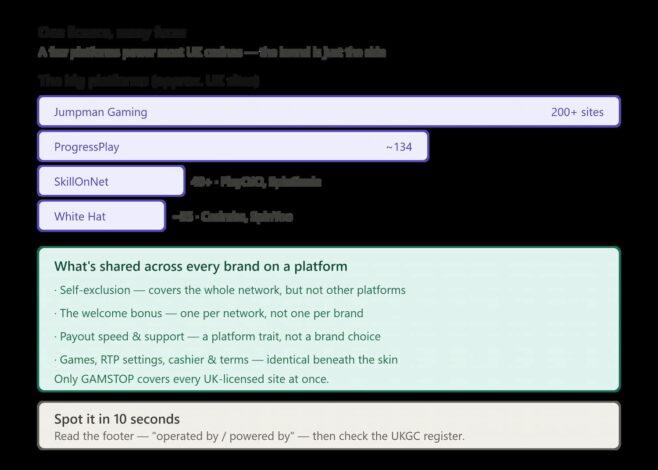
Jumpman Gaming is the largest. It runs dozens of its own brands plus well over a hundred white-label partners — more than 200 casino sites in total, the bulk operating under a single UKGC licence. It was acquired in 2022 by Super Group, the parent of Betway, and its sites are instantly recognisable by the “Mega Reel” spin-the-wheel welcome offer, typically carrying 65x wagering and a £250 lifetime deposit conversion cap — among the most restrictive terms in the UK. Jumpman was fined £500,000 by the Commission for social-responsibility failings.
ProgressPlay runs roughly 134 white-label casinos alongside its own brands. It has been fined twice — £175,718 in 2022 and £1 million in August 2025 — for anti-money-laundering and social-responsibility failures. Tellingly, its welcome bonuses are limited to five brands across the network, which is only possible because the platform tracks your activity across every site on it.
White Hat Gaming powers around 30 to 35 of the slicker, more premium-looking UK casinos — names like Dream Vegas, Casimba, Playzee and SpinYoo. It has a strong reputation for player-account management and faster processing.
Aspire Global (trading as AG Communications, now part of the Aristocrat Interactive ecosystem) runs dozens of brands including Mr Play, Hopa and Luckster. It was fined £1.4 million in June 2025.
SkillOnNet powers another 40-plus brands, among them PlayOJO, SpinGenie and Lord Ping.
Others fill out the picture — Grace Media, Broadway Gaming (which absorbed the bingo-led Dragonfish platform), L&L Europe and more. The headline is simple: a large majority of “new” UK casinos are functionally the same as dozens of existing ones.
How to Spot a White-Label Site in Ten Seconds
The tell is always in the footer. Scroll to the very bottom, past the game logos and the payment icons, and read the small print. Phrases like “Operated by Jumpman Gaming Limited” or “Powered by Aspire Global” name the real operator, and the UKGC licence number sits right beside it.
Then do the thing almost no player does: take that licence number to the Gambling Commission’s public register. The register shows the licence holder — the platform — and you can see it’s the same entity behind a long list of other brands. One licence number, many sites. That’s the family, laid bare. If a casino’s footer hides its operator, or the licence holder turns out to run a hundred other skins, you now know exactly what you’re dealing with.
What’s Actually Shared — and Where It Bites
This is the part that matters, because the sharing goes far deeper than the game lobby. Within a single platform, these things are common across every brand:
Self-exclusion — network-wide, but only within the platform. This is the single most important thing to understand, and it cuts both ways. Exclude yourself from one Jumpman site and you’re excluded from all 200-plus Jumpman sites at once — which is excellent if you wanted out, and a shock if you didn’t realise one click would lock you out of hundreds of casinos you’d never visited. But the exclusion stops at the platform boundary. Self-excluding from a SkillOnNet brand does nothing to your access to a White Hat or Jumpman site. A player who thinks “I’ve self-excluded from my casino” may still be one click from an account on a different network’s skin. The only tool that spans every UK-licensed operator, regardless of platform, is GAMSTOP — which is exactly why it exists, and why it’s the right choice if you want genuine, total coverage. We cover the wider safety picture on our online casinos hub.
The welcome bonus — once per family, not per brand. Because the platform tracks you across every skin by your verified identity, hopping to a sister site for a fresh welcome offer usually doesn’t work. ProgressPlay’s “limited to five brands within the network” term is the mechanism made visible; the platform knows it’s you. The same shared verification means your KYC and any source-of-funds checks follow you around the network too — clear it once, and you’re known across the family.
Payout speed and support — platform traits, not brand traits. If a casino pays slowly, that’s almost always the platform’s withdrawal queue, not the brand’s choice — White Hat and SkillOnNet tend to process faster, Jumpman sites slower, regardless of which skin you used. The same goes for support: agents and dispute handling are shared across the network, so switching to a prettier sister site won’t get you a better queue or a faster payout. If the experience frustrated you on one skin, it’ll frustrate you on all of them.
Games, RTP settings and terms. The lobby, the cashier, the payment methods and the core terms and conditions are common across the network — including the return-to-player versions the platform has configured. Networks frequently run the same RTP build of a game across every brand, and those builds aren’t always the generous ones. The bonus mechanics tend to be near-identical too, which is why every Jumpman site greets you with the same Mega Reel.
Why “Switching Casinos” Often Changes Nothing
Put it together and the practical truth is stark: moving between brands on the same platform isn’t switching casinos. It’s changing the wallpaper. You get the same games at the same RTP, the same payout speed, the same support queue, the same bonus eligibility (often none, second time around), and the same self-exclusion status. The genuine differences in the UK market are between platforms, not between the brands sitting on top of them. Once you can identify the platform, you can predict the experience before you deposit a penny.
The Fragility Nobody Mentions: Brands Vanish
There’s a final wrinkle that turns the academic into the urgent. White-label brands are disposable, and they disappear.
Across late 2025 and early 2026, a wave of Aspire Global brands simply ceased operations — names like Luckland, SpinShake and Cashiopeia went dark, while others such as Karamba and Griffon Casino migrated to the White Hat Gaming licence and carried on under new infrastructure. The trigger was economic: the rise in Remote Gaming Duty to 40% and the 10x bonus-wagering cap squeezed margins to the point where running a long tail of marginal skins stopped paying, and one affiliate noted the platform had already cut some slot RTPs to the regulatory minimum years earlier just to absorb pressure.
For a player, a closing brand is not a trivial event. It raises exactly the questions covered in our guide to what happens to your balance if a casino goes bust — where your funds sit, how protected they are, and how you get them back. The lesson compounds the rest: the skin you trusted can be retired by a head office you’ve never heard of, for reasons that have nothing to do with you.
So Is White-Label Bad?
Not inherently, and it’s worth being fair about it. White-label is simply how most of the market is built. The sites are UKGC-licensed, the games are the same certified titles you’d find anywhere, and the model genuinely lowers the barrier to launching, which keeps the market competitive. Plenty of perfectly good casinos are white-label skins, and a few networks run a tighter, faster, fairer operation than some independents.
The problem isn’t the model. It’s the illusion the model creates — the impression of abundant, independent choice when much of it is the same operation wearing different outfits. Strip away the illusion and you can actually choose well: by platform, with eyes open, knowing what’s shared.
If you’d rather avoid the shared-platform model altogether, our pick of the best casinos not on a shared white-label platform rounds up the genuine independents.
The Playbook: How to Use This
Read the footer before you sign up. The “operated by” or “powered by” line, plus the licence number, tells you who you’re really dealing with.
Check the UKGC register if it matters to you. One search reveals every sister brand under the same licence — and whether your “independent” find is one of a hundred clones.
Don’t chase sister-site bonuses. If you’ve claimed a welcome offer on one brand in a network, the platform usually knows, and a second offer on a sister skin won’t land. For genuinely different terms, you need a different platform — compare offers properly on our casino bonuses guide.
Judge by platform, not skin. Slow payouts, weak support and stingy RTP configs are network traits. If they bothered you once, switching wallpaper won’t fix them.
Understand your self-exclusion scope. Excluding from one brand covers its whole network but not others. If you want to step away properly, GAMSTOP is the only tool that covers every UK-licensed site at once.
The casino industry spends a great deal of effort making each brand feel like a fresh, independent choice. Spend ten seconds on the footer and the UKGC register, and you’ll see the family behind the faces — which is the only way to choose between them on what actually matters, rather than on the colour of the logo.
FAQs About White-Label Casinos
What is a white-label casino? A casino brand that rents its platform, game library, cashier, support and often its UK licence from a provider like Jumpman, White Hat Gaming, Aspire Global or SkillOnNet, then adds its own name and design. Beneath the skin it’s the provider’s operation.
How do I tell if a casino is white-label? Check the footer for an “operated by” or “powered by” line and the UKGC licence number, then look that number up on the Gambling Commission’s public register. If the licence holder runs many other brands, it’s a white-label network.
If I self-exclude from one site, am I excluded from its sister sites? Yes, within the same platform — excluding from one Jumpman site excludes you from all of them. But it doesn’t carry across to other platforms. For exclusion from every UK-licensed casino at once, use GAMSTOP.
Can I claim a fresh welcome bonus at a sister casino? Usually not. The platform tracks players across all its brands by verified identity, so a welcome offer claimed on one skin typically blocks it on the others in the same network.
Does the platform affect how fast I get paid? Yes. Withdrawal speed is largely a platform trait. Some networks process faster than others, and switching to a sister brand on the same platform won’t change your payout times or support experience.
Are white-label casinos safe? They’re as regulated as any UKGC-licensed site — same licensing, certified games and responsible-gambling rules. The main caveat is the illusion of choice, and the fact that individual brands can close or migrate platforms.
Why do so many casinos look the same? Because they share a platform. The game lobby, cashier, payment methods, bonus mechanics and even RTP configurations are common across every brand on a network, so only the branding really differs.
What happens to my account if a white-label brand closes? It can be retired or migrated to another platform, as happened with several Aspire Global brands in 2025–26. How easily you recover your balance depends on the operator’s fund protection — see our guide on what happens if a casino goes bust.
Is an independent casino better than a white-label one? Not automatically. Independents can offer more distinctive games, custom bonuses and faster dispute handling, but some white-label networks run a slicker, faster operation. The point is to know which you’re choosing.
Which platform powers the most UK casinos? Jumpman Gaming is the largest, with over 200 sites under a single licence, followed by networks like ProgressPlay, SkillOnNet, White Hat Gaming and Aspire Global.
18+. Play responsibly. Gambling can be addictive. For free, confidential support visit BeGambleAware.org or call the National Gambling Helpline on 0808 8020 133. This guide is general information; platform ownership and brand portfolios change frequently, so check the footer and the UKGC register for current details.
Written by: Jamie Shaw