Volatility Explained: Why Two 96% RTP Slots Feel Completely Different
Volatility Explained: Why Two 96% RTP Slots Feel Completely Different
Put two slots side by side. Both advertise 96% return to player. One drips small wins every few spins and keeps your balance ticking along for an hour on a tenner. The other eats forty spins without a flicker, then suddenly pays 800 times your stake. Same RTP, wildly different night. The number that explains the gap isn’t on the box as prominently as RTP, gets explained the least, and matters more than RTP for almost every session you’ll ever play. It’s volatility.
If you only ever learn one thing about how slots behave, make it this distinction, because RTP answers a question most players don’t actually care about — how much comes back over millions of spins — while volatility answers the one they do: what’s going to happen to my money tonight. Here’s what volatility really is, why two identical-RTP games feel like different sports, and how to use it.
RTP and Volatility Answer Two Different Questions
Start by separating the two cleanly, because they’re constantly muddled.
RTP is how much. A 96% RTP means that across millions of spins, the game returns £96 for every £100 staked. It’s a long-run average, and the operative words are long run — we’re talking hundreds of thousands of spins, not your Friday session. RTP tells you nothing about the shape of the ride.
Volatility is how. It describes how that 96% is delivered: in a steady stream of small wins, or in long droughts punctuated by rare, enormous hits. Same destination, completely different road. As one neat summary puts it: RTP is long-term maths; volatility is how the game feels in a real session.
This is why the headline you should actually read is volatility, not RTP. Over a few hundred spins — which is all most bankrolls last — RTP barely asserts itself, while volatility dominates every minute of the experience. The 96% is a promise the game only keeps over a timescale you’ll never personally play.
What’s Actually Happening Under the Hood
Volatility is a measure of spread — in statistical terms, the standard deviation of a game’s outcomes. A low-volatility slot has a tight distribution: most spins land close to the average, so results are relatively predictable. A high-volatility slot has a wide distribution: the overwhelming majority of spins land below average, and a tiny handful land spectacularly above it. That asymmetry is the whole story.
Here’s the uncomfortable truth buried in the maths. On a high-volatility game, the big win exists because of all the dead spins around it. The model can only afford that 800x hit by taking back the stake on dozens of nothing spins first. Players remember the huge payout; the maths remembers every empty spin required to fund it. The thrill and the drought are the same mechanism viewed from two ends.
Two further numbers flesh this out:
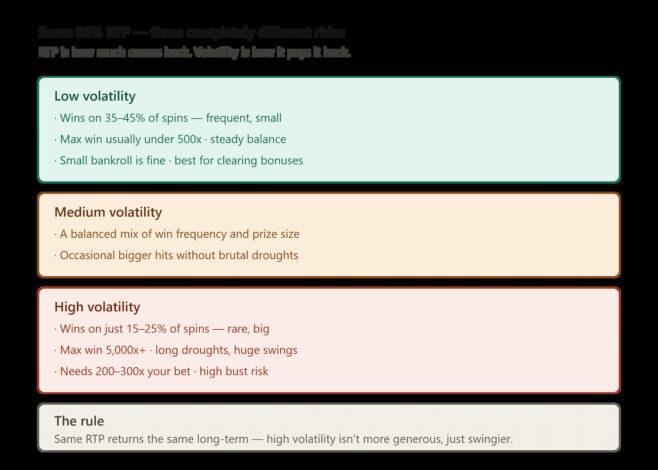
Hit frequency — how often any win lands at all. A low-volatility slot might pay something on 35–45% of spins; a high-volatility one on just 15–25%. That’s the difference between a win every two or three spins and a win every five or six — and it’s why one game feels generous and the other feels broken, long before either has shown you its real RTP.
Maximum win — the quickest tell of all. A top payout under around 500x your stake signals low volatility; a max win of 5,000x or more signals high. Before you spin, the advertised max win tells you almost everything about the ride you’re in for: a big number means big droughts.
Two 96% Slots, One £100 Bankroll
Make it real. Take £100, bet £1 a spin, and run it through two 96% games.
On the low-volatility slot, wins land often and small. Your balance drifts down gently, with frequent little top-ups that keep you in the chair. You’ll likely get a few hundred spins out of your hundred quid, plenty of small moments, and a slow, survivable fade toward that 4% house edge. The risk of busting before you’ve had a decent session is modest.
On the high-volatility slot, the same £100 behaves like a different currency. Long cold streaks chew through it fast, because the frequent small wins that cushioned you simply aren’t there — you’re paying full stake into drought after drought while you wait for a feature that may never trigger in your budget. The probability of losing the whole bankroll before a meaningful win lands is dramatically higher. The flip side, of course, is that if the big hit comes, it dwarfs anything the low-volatility game could produce.
This is what professionals call risk of ruin — the chance you lose your stake before reaching a win — and it scales sharply with volatility. The same £100 that comfortably survives a low-volatility session can have a coin-flip-or-worse chance of vanishing on a high-volatility one. Which leads to the single most practical rule in slots: match your bankroll to the volatility. High-volatility games realistically need a bankroll of 200–300 times your bet to ride out the dry spells; the same budget stretches far further, and more enjoyably, on a low-volatility game. Bet £1 a spin on a high-volatility slot with £40 in the account and you’re not really chasing the big win — you’re funding the next player’s.
Why You Can’t “Feel” RTP — But Can Feel Volatility
A persistent myth says you can sense whether a slot is “paying” in a few spins. You can’t sense RTP that way — it only emerges over hundreds of thousands of spins, and every spin is independent of the last; the reels have no memory of being “due.” What you can feel almost immediately is volatility, because the rhythm of wins and droughts is the volatility showing itself in real time.
That distinction also kills the related myth that high volatility means a slot “pays more.” It doesn’t. Volatility governs the distribution of returns, not the total. A high-volatility 96% slot and a low-volatility 96% slot return the same over the long run — one just delivers it in rarer, bigger lumps. Reach for high volatility for the shape of win you want, never in the belief it’s more generous. And remember that the long droughts are the design working exactly as intended, not a rigged or “cold” machine — a point that follows directly from how UK slot outcomes are generated and regulated.
The Bonus Trap Nobody Warns You About
Here’s where volatility quietly costs people real money, and it ties straight into casino bonuses. When you’re handed free spins or a deposit bonus with wagering attached, the volatility of the game you clear it on matters enormously.
Low-volatility slots are the smart choice for clearing a wagering requirement, because their frequent, steady returns keep your balance alive long enough to complete the playthrough. High-volatility slots are the opposite trap: you can burn through 50 free spins triggering nothing, end with a few pennies, and lose any realistic chance of meeting the requirement before your balance is gone. The steady grind beats the lottery ticket when there’s a wagering target to hit. With the bonus landscape already tighter under the 10x wagering cap and the 40% gaming tax, squandering a bonus on a high-volatility game is a costlier mistake than it used to be — pick the volatility to match the job.
Live tables behave differently again — if you prefer dealers to reels, see the best UK live dealer casinos and how their bonuses work.
How to Find a Slot’s Volatility
It isn’t always labelled, but you can establish it in three ways. Check the game’s info or paytable screen first — many providers now state a volatility rating, and some show a star or number scale. If it’s not stated, read the max win: under 500x leans low, over 5,000x leans high. And use demo or play-money mode to feel the rhythm before you risk real cash — track wins over a hundred spins, and a hit landing on a third to nearly half of them tells you low, one landing on a fifth tells you high.
One thing to note: volatility is baked into the game’s maths by the developer and, unlike RTP, isn’t something the casino or you can adjust. It’s a fixed property of the design, so once you know a game’s volatility, it’s the same wherever you play it.
Choosing the Right Volatility for You
There’s no “best” volatility — only the right one for your bankroll, your patience and your goal.
Choose low volatility for longer, steadier sessions on a smaller budget, for maximum playing time per pound, and for clearing bonuses — NetEnt’s Blood Suckers, with a very high RTP and low volatility, is a long-standing favourite for exactly this. Choose medium for a balance of win frequency and the occasional bigger hit. Choose high volatility only when you have the bankroll to absorb long droughts and you’re genuinely chasing a large, rare win rather than a long session — and accept that most sessions on it will end cold. The one combination to avoid is low RTP and low volatility: small wins and a weak return is the worst of both worlds, with little upside to justify it.
The smartest players treat volatility as the primary filter and RTP as the tie-breaker: decide what kind of ride you want first, then pick the highest-RTP game that delivers it. Get that order right and you’ll stop being surprised that two “96% slots” emptied your wallet at completely different speeds. For the wider picture of how UK casino games work, our online casinos hub is the place to start.
FAQs About Slot Volatility
What’s the difference between RTP and volatility? RTP is how much a slot returns over the very long run — 96% means £96 back per £100 across millions of spins. Volatility is how it returns it: low volatility pays small and often, high volatility pays big and rarely. Same RTP can mean a completely different session.
Is volatility the same as variance? Effectively, yes. The terms are used interchangeably in slots. Strictly, variance is the longer-term measure and volatility the shorter-term feel, but for practical purposes they describe the same thing — the spread of outcomes.
Does high volatility mean a slot pays more? No. Volatility governs the distribution of wins, not the total. A high-volatility and a low-volatility slot with the same RTP return the same over time; the high-volatility one just delivers it in rarer, larger amounts.
What is hit frequency? How often any win lands. Low-volatility slots hit on roughly 35–45% of spins, high-volatility ones on 15–25%. It’s why one game feels generous and another feels dead, regardless of RTP.
How can I tell a slot’s volatility? Check the info/paytable screen for a stated rating, read the maximum win (under 500x leans low, over 5,000x leans high), or play demo mode and track how often wins land over 100 spins.
Which volatility is best for bonuses and wagering? Low volatility. Its steady wins keep your balance alive long enough to clear a wagering requirement. High-volatility slots risk busting your balance before you finish, wasting the bonus.
What bankroll do I need for a high-volatility slot? As a rule of thumb, around 200–300 times your bet size to ride out the dry spells. The same budget lasts far longer on a low-volatility game.
Can a slot’s volatility be changed by the casino? No. Volatility is fixed in the game’s design by the developer. Unlike RTP, which can sometimes be offered in different configured versions, volatility is the same wherever you play that title.
Why did two 96% slots empty my balance at different speeds? Volatility. The high-volatility one took your stake through long winless droughts while you waited for a rare big hit; the low-volatility one fed back small wins that stretched the session. Same long-term return, very different short-term ride.
Can I feel whether a slot is “hot” or “due”? No. Every spin is independent and the game has no memory, so a slot is never “due.” What you can feel quickly is its volatility — the rhythm of wins and droughts — but not its RTP, which only emerges over enormous numbers of spins.
18+. Play responsibly. Gambling can be addictive. For free, confidential support visit BeGambleAware.org or call the National Gambling Helpline on 0808 8020 133. This guide is general information; game maths varies by title, so check each slot’s paytable before playing.
Written by: Jamie Shaw