How Online Slots Are Made, Priced and Configured
How Online Slots Are Made, Priced and Configured
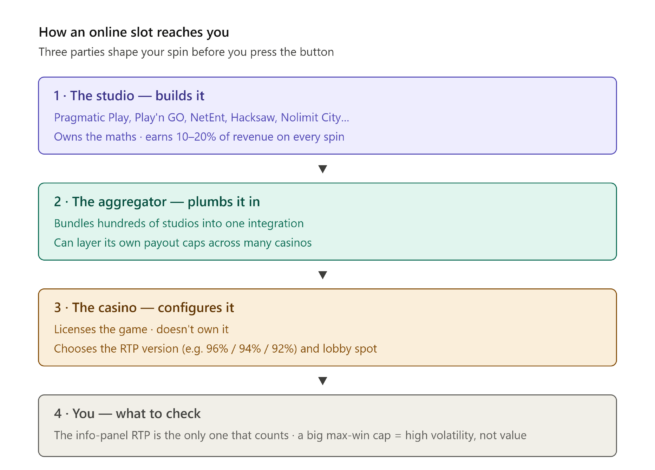
When you load a slot, you assume the casino made it, or at least chose it, set its odds and decides what it pays. Almost none of that is true. The casino didn’t build the game, doesn’t own it, and — on the part that matters most, the return-to-player percentage — is often just picking from a menu of versions someone else prepared. Behind every spin sits a supply chain most players never see: a studio that built the maths, an aggregator that plumbed it in, and a casino that selected which configuration to run and where to place it in the lobby.
Understanding that chain answers four questions players ask separately but which are really one question. Who actually makes the slots? What does a game cost the casino, and how does that shape what you’re shown? Why can the same slot pay 96% on one site and 94% on another? And what is that “max win 5,000x” badge really promising? Follow the money from the studio to your screen and all four fall into place — and you come away able to read a slot the way the industry does.
Who Actually Makes the Slots
Start at the source. The casino is a shopfront; the games are built by specialist B2B studios that sell to the whole market. A handful dominate. Pragmatic Play, Malta-based and founded only in 2015, has become the most distributed of all, pumping out new titles weekly across slots, live casino and more. Play’n GO, NetEnt (now owned by Evolution, the same group behind the live-casino studios and the Megaways patent), Hacksaw Gaming and Nolimit City round out the names you’ll see again and again. A specialist studio builds the slot; the casino merely licenses it — which means the same Gates of Olympus or Big Bass Bonanza you play at one site is the identical game, from the identical maker, at a dozen others.
This is the games-side mirror of the white-label platform map: just as one platform can power 200 casino brands, one studio’s catalogue appears across hundreds of casinos. The studio, not the casino, designs the game and owns its maths.
Most casinos don’t even integrate each studio directly. They plug into an aggregator — a middleman platform that bundles hundreds of studios behind a single technical connection, so a casino can offer thousands of games from dozens of makers through one integration. The aggregator sits between studio and casino, and as we’ll see, it can impose its own rules on top — including on payout caps. Three layers, then, stand between the game’s creator and you: studio, aggregator, casino.
What a Slot Costs the Casino — and Why It Shapes Your Lobby
Here’s where the operator-economics get interesting, because the casino doesn’t buy a game outright. It rents it, and it pays per spin.
The standard arrangement is revenue share: the studio takes a percentage of the gross gaming revenue the game generates — typically somewhere between 10% and 20% of what players lose on it, with the aggregator taking a further slice on top. There’s usually no flat fee; the studio earns only when the game earns, which is why studios are relentless about release cadence and chasing hits. A studio takes a cut of every spin; the cut means the casino keeps only part of what a game wins.
That single fact quietly shapes what you see. Because every game on the shelf costs the casino a share of its revenue, the operator has a strong incentive to push the titles that maximise its retained margin — and that interacts directly with the next two pieces of the chain. The economics also explain the modern lobby’s obsession with a handful of mega-hits: a title like Gates of Olympus isn’t just popular, it’s an acquisition channel in its own right, one of the most-searched slots on earth, so casinos feature it to capture players hunting for it. Revenue share rewards hits; the pursuit of hits shapes the lobby you scroll.
It also explains why this whole supply chain has tightened since the Remote Gaming Duty rose to 40%. When the tax takes 40p of every £1 of gross win, and the studio takes another 10–20% on top, the margin a casino keeps per spin is thinner than ever — which sharpens the incentive to pull the one lever the casino fully controls. That lever is RTP.
Why the Same Slot Pays 96% Here and 94% There
This is the part that genuinely shocks players, and it deserves its own clear explanation because you’ve likely been affected by it without knowing.
Many studios don’t ship a slot at a single return-to-player percentage. They ship it in multiple configured versions, and the casino chooses which one to run. The game looks identical — same graphics, same features, same Zeus, same fishing trips — but the underlying maths differs. Pragmatic Play’s headline titles commonly come in versions around 96.5%, 94.5% and lower; Big Bass Bonanza has documented configurations at 96.5%, 94.5% and 92%. Play’n GO goes further still — its Moon Princess ships in five published versions, from 96.5% all the way down to 84.5%. A studio publishes multiple RTP versions; the operator selects which version runs.
Sit with what that means. Two casinos can offer you the “same” slot at materially different odds, and the choice is the operator’s, not yours. On a £1,000 of total wagering, a 96.5% version is expected to cost you around £35; a 92% version of the identical game, around £80 — more than double, for a session that looks and feels exactly the same. The version you play determines your real cost; the operator, not the player, sets the version. And in the toughest cases, providers allow operators to configure RTP down to around 84% — a brutal house edge wearing the costume of a game you trust.
There is one protection, and you should use it every time. In the UK, casinos must display the actual RTP of the version running, and the Gambling Commission treats a displayed figure that doesn’t match the live configuration as a serious breach tied to responsible-gambling duties. So the headline RTP in a slot review is only the studio’s default — the number that counts is in the game’s own information or paytable panel, showing what this casino has set for this version. The info panel states the live RTP; the live RTP is the only one that affects your money. Check it before you spin, because the same title genuinely varies between sites, and the more generous operators compete precisely by running the higher versions of their hero games.
What “Max Win 5,000x” Is Really Promising
The fourth piece of the chain is the badge slapped across modern slots: Max win 5,000x! 10,000x! 50,000x! Unlimited! It’s marketing, but it’s also a hard mathematical ceiling, and the way it interacts with the rest of the maths is widely misunderstood.
A max-win cap is the most a game will ever pay on a single spin or feature, no matter what the reels do. The studio sets it as part of the game’s design — it’s how the maths balances a slot capable of the occasional enormous hit. The cap defines the ceiling; the ceiling is part of how the RTP is funded. A slot advertising a 5,000x maximum has built its whole return model around that limit, and once you hit it, the win stops counting up however good the combination.
Two traps live here. First, where a game lists both a multiplier ceiling and a fixed currency maximum, the lower of the two governs — so a “10,000x” badge can be quietly overridden by a fixed cash cap imposed by the studio, the aggregator or the operator, and the aggregator layer can enforce currency-equivalent caps across many casinos at once. The advertised multiplier is a headline; the real ceiling is the lower of the two figures. Second — and this is the crucial player point — a high or “unlimited” cap is not generosity. It’s the opposite of free. On a fixed-RTP game, an enormous max-win potential has to be paid for somewhere, and it’s paid for by a colder base game and brutal volatility, exactly the trade-off we set out in why two 96% slots feel completely different. A bigger ceiling buys a rarer, swingier ride, not a richer one. The headline cap signals volatility; the volatility is the price of the dream.
There’s a final overlap worth flagging, because it stacks. A game’s max-win cap is separate from a bonus’s max-cashout cap. You can hit a capped game win and still have your withdrawal constrained by a promotion’s conversion limit — two different ceilings, applied in sequence, neither obvious until it bites.
Reading a Slot the Way the Industry Does
Put the whole chain together and a slot stops being a black box. It was built by a studio that owns its maths and earns a slice of every spin; delivered through an aggregator that may impose its own caps; and configured by a casino that chose which RTP version to run and where to rank it in the lobby. Three parties shaped your spin before you ever pressed the button, and the casino’s name on the door is the least informative thing about it.
The practical edge this gives you is real. Read the in-game info panel for the live RTP, not the review’s headline, because the version is the casino’s choice and it varies. Treat a giant max-win badge as a volatility warning, not a value promise. Recognise that the games pushed hardest in the lobby are pushed for the operator’s margin, not your odds. And remember that the most generous casinos reveal themselves not through the size of a welcome offer but through the quiet decision to run the higher RTP versions of the games you actually play. For the wider picture of how UK casino games and their economics work, our online casinos hub is the place to start.
FAQs About Who Controls the Slots
Does the casino make its own slots? Almost never. Slots are built by specialist B2B studios like Pragmatic Play, Play’n GO, NetEnt, Hacksaw and Nolimit City, then licensed to casinos — often through an aggregator that bundles many studios into one integration. The casino is a shopfront for games it doesn’t own.
How do studios get paid? Mainly through revenue share — the studio takes a percentage of the gross revenue a game generates, typically 10–20%, with the aggregator taking a further cut. There’s usually no flat fee, so studios earn only when their games earn, which drives their relentless release schedules.
Why does the same slot have different RTP at different casinos? Because many studios ship a game in several configured RTP versions — for example 96.5%, 94.5% and 92% — and the operator chooses which one to run. The game looks identical; only the maths differs. Some versions go as low as around 84%.
How do I check the real RTP of a slot? Open the game’s information or paytable panel, which in the UK must show the RTP of the version actually running. Don’t rely on a review’s headline figure — that’s the studio’s default, and your casino may be running a lower-configured version.
Is a higher max win better for me? Not necessarily. A large or “unlimited” max-win cap is funded by higher volatility and a colder base game, so it buys a rarer, swingier experience rather than a more generous one. The cap signals risk, not value.
What happens if a slot advertises 10,000x but also has a cash cap? The lower of the two limits governs the payout. A fixed currency maximum, sometimes imposed by the aggregator or operator rather than the studio, can override the headline multiplier — so check the game’s stated maximum payout, not just the multiplier badge.
Is the game max win the same as a bonus max cashout? No — they’re separate ceilings. You can hit a capped game win and still have your withdrawal limited by a promotion’s max-cashout term. Both can apply to the same win, one after the other.
Why do the same few slots appear at the top of every lobby? Because revenue share and player demand both reward hits. Mega-popular titles like Gates of Olympus are acquisition channels in their own right, so casinos feature them prominently — placement reflects the operator’s economics, not your odds.
Does the studio or the casino set the house edge? Both, in different ways. The studio designs the maths and the available RTP versions; the casino chooses which version to deploy. The house edge you actually face is the result of the operator’s configuration choice.
Are configurable RTP versions legal in the UK? Yes, but the displayed RTP must match the version actually running. The Gambling Commission treats a mismatch between the advertised and live RTP as a serious breach, which is why the in-game info panel is your reliable source.
18+. Play responsibly. Gambling can be addictive. For free, confidential support visit BeGambleAware.org or call the National Gambling Helpline on 0808 8020 133. This guide is general information; commercial arrangements, RTP versions and game caps vary by studio and operator, so check each game’s paytable before playing.
Written by: Jamie Shaw