
Megaways, Decoded: How 117,649 Ways to Win Actually Works
Megaways, Decoded: How 117,649 Ways to Win Actually Works
You’ve seen the number plastered across slot lobbies — 117,649 ways to win! — and probably wondered whether it’s marketing nonsense or a real figure. It’s real, it’s the same number on almost every Megaways game, and there’s a single, elegant piece of maths behind it that, once you see it, explains the whole format: why the reels change shape every spin, why the wins feel different, and why one mechanic invented by a small Australian studio now powers a huge chunk of the slots you play.
This is the explainer most Megaways guides don’t actually deliver. They tell you it’s “dynamic and exciting.” Here’s how it genuinely works — the number, the licensing empire behind it, and the RTP nuances buried in the reels that decide whether a given Megaways title is worth your time.
Where 117,649 Comes From
Start with the number, because it’s the key to everything. A standard slot has a fixed shape — a 5×3 grid gives 243 ways to win, and that never changes. Megaways throws that out. On a Megaways slot, each reel displays a random number of symbols on every single spin, anywhere from two to seven.
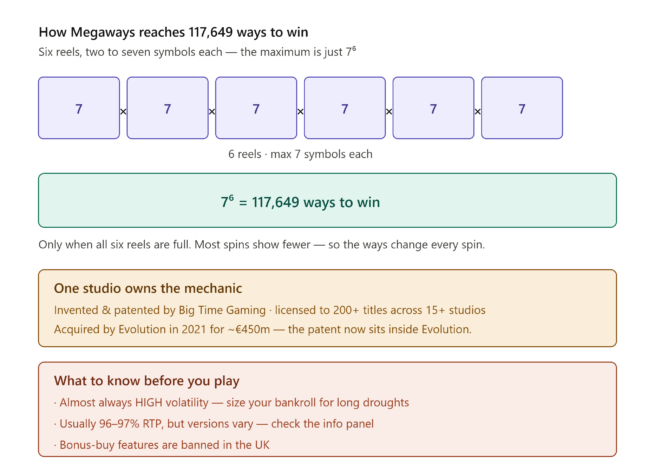
Now the maths. A standard Megaways game runs six reels, and each can show up to seven symbols. The total number of ways to win is simply the symbols on each reel multiplied together. When all six reels land their maximum of seven, that’s 7 × 7 × 7 × 7 × 7 × 7 — seven to the sixth power — which equals exactly 117,649. That’s the headline figure: the maximum possible combinations when every reel is full. The Megaways mechanic generates up to 117,649 ways to win, and the figure is identical across most six-reel titles because the underlying arithmetic is identical.
Crucially, you only hit that ceiling when all six reels are maxed out simultaneously. Most spins show fewer — a reel of three here, a reel of five there — so the active number of ways changes spin to spin, displayed live on screen and recalculated every time the reels stop. A reel landing two symbols on one spin and seven on the next is the entire visual signature of the format. Variable reel height creates the dynamic ways count; the dynamic ways count is what makes no two Megaways spins look alike.
Some titles push past the standard ceiling with extra mechanics. Games with expanding reels or additional rows can reach 200,704 ways or more, and a handful — like 1 Million Megaways BC — break a million. But 117,649 is the canonical number, and now you know it’s not hype: it’s 7⁶.
One Studio, One Patent, an Entire Genre
Here’s the part that surprises people. Every Megaways slot you’ve ever played, whoever made it, traces back to one company. Big Time Gaming, an Australian studio founded in Sydney in 2011, developed the Megaways mechanic and first deployed it in Dragon Born in 2016, then popularised it later that year with Bonanza — the mining-themed game that turned Megaways into a global phenomenon.
What makes this commercially fascinating is that Big Time Gaming holds the Megaways patent. The mechanic isn’t a free-for-all; it’s intellectual property. Any other studio that wants to build a Megaways title must license the engine from BTG. And license it they have — Pragmatic Play, Blueprint Gaming, Red Tiger, Iron Dog and many more have all paid to use it, which is why you’ll find Megaways versions of everything from Monopoly to Fishin’ Frenzy made by completely different developers. Blueprint Gaming licenses the Megaways engine from Big Time Gaming; Big Time Gaming owns the mechanic that more than 200 titles across 15-plus studios now run on.
The endgame tells you how valuable that patent is. Evolution — the live-casino giant we covered in how live casino studios work — acquired Big Time Gaming in 2021 for around €450 million. Evolution acquired Big Time Gaming in 2021; the Megaways patent is now an asset inside the Evolution group, which means a single corporate parent both dominates live dealer and owns the mechanic behind a vast slice of the slots market.
The Engine: Cascades and the Unlimited Multiplier
The variable reels are only half the appeal. The other half is what happens after a win, and it’s why Megaways sessions can suddenly explode.
Megaways almost always pairs with cascading reels — called Reactions in Bonanza. When a winning combination lands, those symbols are removed and new ones drop in to fill the gaps, which can trigger fresh wins from the same spin, chaining again and again. Cascading reels turn one spin into a potential streak of wins, and the chaining is what makes the format feel generous in bursts even when it isn’t, long-term.
The real fireworks live in the free-spins round, where most Megaways titles run an unlimited multiplier. In Bonanza, the bonus is triggered by spelling G-O-L-D across the reels for twelve free spins, and inside that round the win multiplier starts at 1x and climbs by one with every cascade — with no cap and no reset for the entire feature. A long chain of cascades late in the round, with the multiplier into double figures, is where the format’s legendary wins come from. The unlimited multiplier rewards long cascade chains; the long cascade chains are what produce the five-figure-multiple wins that built Megaways’ reputation on streaming sites. Bonanza’s documented maximum is around 26,000 times your stake; some licensed titles, like Lil’ Devil, go far higher.
The RTP Nuance Buried in the Reels
This is where Megaways earns a closer look than the average slot, and where the genuinely useful detail sits — because Megaways and return-to-player have a more interesting relationship than the marketing lets on.
Most Megaways slots sit in the 96–97% RTP range, broadly average for video slots. But the spread is wide, and two things move it. First, operators can run different RTP versions of the same Megaways title — the configured-RTP point we made in how UK slots were redesigned applies in full here, so the same game can return 96% on one site and a lower build on another. Always read the in-game information panel, which shows the live figure for the version you’re actually playing. The information panel states the operative RTP; the operative RTP can differ between casinos.
Second, a few Megaways titles are genuine RTP outliers. White Rabbit Megaways carries an RTP of around 97.72%, exceptionally high for any slot, because it uses an expanding-reel mechanic and its base return is mathematically tuned to its extreme win potential. In markets where RTP must be displayed, a game like that stands out in any RTP-sorted list — a real edge if you hunt for it deliberately.
But the number that matters most on a Megaways slot isn’t RTP at all — it’s volatility, and Megaways games are almost uniformly high. The variable reels and the unlimited-multiplier bonus create exactly the wide outcome distribution we explained in why two 96% RTP slots feel completely different: most spins land below average, and a rare few land enormously above it. The Megaways mechanic creates high volatility; high volatility demands a larger bankroll to ride out the long droughts. Bonanza’s hit frequency is around 37% — roughly one win every 2.7 spins — but most of those are small, and the big money is locked behind a bonus round you might wait hundreds of spins to see. Treat any Megaways slot as a high-variance game and size your stake accordingly, however inviting that 117,649 sounds.
The Bonus Buy — and Why the UK Banned It
Many Megaways titles offer a bonus buy (or feature buy): pay a fixed multiple of your stake, often around 90–100x, to skip straight into the free-spins round rather than waiting for it to trigger. It’s popular with players who want the multiplier action without the grind, and the buy-feature RTP is sometimes marginally different from the base game.
But you won’t find it on a UK-licensed site. Bonus-buy mechanics are banned in Great Britain, because paying a lump sum to jump into a high-volatility bonus encourages exactly the fast, high-stake play the regulator has spent years designing out — the same logic behind the 2.5-second spin and stake caps in our slot-rules guide. The UK Gambling Commission prohibits feature buys; feature buys remain available in some other jurisdictions. If you see one offered, it’s a quiet sign you’re not on a UK-regulated casino — worth noting for all the protection reasons that licence brings.
What Megaways Is, Once You Strip the Marketing
Put it together and Megaways is less mysterious than the lobby makes it look. It’s a patented reel modifier that randomises symbol counts to generate up to 117,649 ways to win, licensed by one Evolution-owned studio to the rest of the industry, almost always wrapped in cascading reels and an unlimited free-spins multiplier, and almost always high volatility. It’s genuinely innovative and genuinely fun — but it isn’t more generous than a standard slot. The same RTP rules apply; the format just delivers its return in a wilder, swingier shape, which is the whole point and also the whole risk.
Knowing the maths changes how you play it: read the RTP version in the info panel, treat it as high-variance, size your bankroll for droughts, and enjoy the 117,649 for what it is — a beautiful piece of arithmetic, not a promise. For the wider picture of how UK casino games and their economics work, our online casinos hub is the place to start.
FAQs About Megaways Slots
What does 117,649 ways to win mean? It’s the maximum number of winning combinations on a standard six-reel Megaways slot, reached when every reel shows its maximum of seven symbols: seven to the sixth power equals 117,649. On most spins the reels show fewer symbols, so the active ways are lower and change every spin.
Who invented Megaways? Big Time Gaming, an Australian studio founded in 2011, created the mechanic and launched it in Dragon Born and then Bonanza in 2016. It holds the patent and licenses the engine to other developers.
Why do so many different studios have Megaways slots? Because they license the mechanic from Big Time Gaming, which owns the patent. Pragmatic Play, Blueprint, Red Tiger and many others pay to use the engine, which is why over 200 Megaways titles exist across more than 15 studios.
Do Megaways slots have good RTP? Most sit around 96–97%, broadly average. A few are outliers — White Rabbit Megaways runs about 97.72% — but operators can configure different RTP versions of the same game, so always check the in-game information panel.
Are Megaways slots high volatility? Almost always, yes. The variable reels and unlimited-multiplier bonus create big swings, with rare large wins behind long droughts. Treat them as high-variance and size your bankroll accordingly.
What are cascading reels? A mechanic where winning symbols are removed and new ones drop in to replace them, potentially creating more wins from a single spin. In the free-spins round this often drives an unlimited, ever-climbing multiplier.
Can I buy the bonus round on a Megaways slot? Not in the UK. Bonus-buy features are banned on UK-licensed sites because they encourage high-stakes, high-speed play. They exist in some other jurisdictions, so seeing one offered suggests the casino isn’t UK-regulated.
Is the 117,649 figure just marketing? No — it’s a genuine mathematical maximum (7⁶). It’s identical across most six-reel Megaways games because the arithmetic is identical, and you only reach it when all six reels are full.
Does a higher ways count mean I’m more likely to win? More ways means more potential winning lines on a given spin, but it doesn’t change the game’s overall RTP or make it more generous. Volatility and RTP, not the headline ways number, determine how it actually pays.
Who owns Megaways now? Evolution acquired Big Time Gaming in 2021 for around €450 million, so the Megaways patent now sits within the Evolution group — the same company that dominates the live-casino market.
18+. Play responsibly. Gambling can be addictive. For free, confidential support visit BeGambleAware.org or call the National Gambling Helpline on 0808 8020 133. This guide is general information; game mechanics and RTP versions vary by title and operator, so check each game’s paytable before playing.