How Casinos Detect Problem Gambling: The Surveillance You Never See
How Casinos Detect Problem Gambling: The Surveillance You Never See
Every time you log in to a UK casino, something is watching how you play. Not a person leaning over your shoulder, but a system — quietly logging how much you deposit, how fast, at what hour, how your behaviour today compares with your behaviour last month, and whether the shape of it matches patterns the operator has been told to treat as warning signs. Most players have no idea it exists. By law, it has been running on their account since the moment they opened it.
This isn’t a conspiracy; it’s a licence condition. UK-licensed operators are legally required to monitor customers for signs of gambling harm and to act on what they find. The system has a name in the rulebook — customer interaction — and a defined list of “markers of harm” it must look for. Understanding what those markers are, what trips them, and what happens next demystifies one of the least-understood parts of online gambling: why a perfectly ordinary session can suddenly prompt a pop-up, an email, a friendly-but-pointed live-chat message, or a request for documents.
Why the Monitoring Exists at All
Start with the legal spine, because it explains everything that follows. Under Social Responsibility Code Provision 3.4.3 of the Gambling Commission’s licence conditions, every remote operator must run effective systems to identify harm or potential harm from the moment an account is opened. The phrase “from the point when an account is opened” is deliberate — the regulator explicitly does not want operators waiting for a long pattern of damage to build before they look. SR Code 3.4.3 mandates behavioural monitoring; behavioural monitoring begins the moment your account is opened.
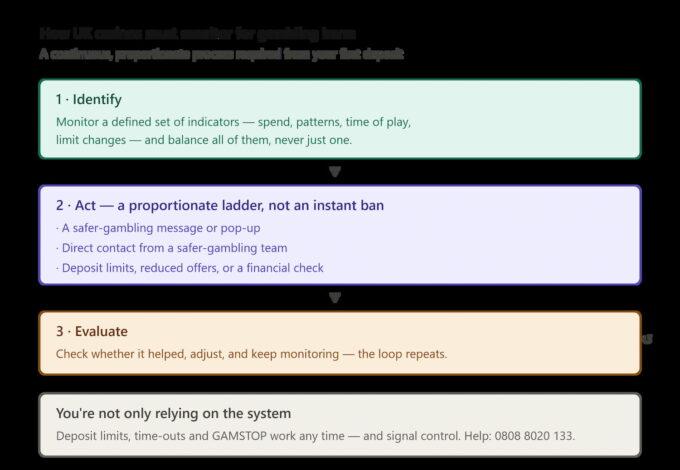
The framework is built on three words operators must embed: identify, act, evaluate. Identify customers at risk; act in a timely, proportionate way; then evaluate whether the action worked and what to do next. It’s a continuous loop, not a one-off check, and the Commission requires operators to interact often enough to at least match the published problem-gambling rate for the activity. In other words, doing too little is itself a breach — which is precisely why this monitoring has become so much more aggressive in recent years.
The Markers of Harm: What the System Actually Watches
Here’s the part players never see spelled out. The Commission doesn’t leave operators to guess; it mandates the categories of indicator they must, at minimum, monitor. Knowing them tells you exactly what the machine is reading.
Customer spend. The bluntest signal — how much money you’re putting in. Large absolute amounts draw attention, but so does spend that looks high relative to you. The system monitors deposit totals over rolling windows, and a figure that jumps well above your own baseline is a flag in itself.
Patterns of spend. More revealing than the total. Depositing five times in an hour, increasing deposits in quick succession, repeatedly topping up straight after a loss (“chasing”), or cancelling a withdrawal to keep playing — these shapes matter more than the raw number. Rapid, escalating, loss-chasing deposit patterns are among the strongest markers the system weights.
Time and duration. How long you play and, critically, when. Long unbroken sessions are a flag, and operators are specifically required to monitor overnight gambling — play in the small hours is treated as a heightened risk indicator, because sustained late-night sessions correlate with harm. Overnight play triggers closer scrutiny; the closer scrutiny exists because night-time sessions signal elevated risk.
Behavioural indicators. Subtler in-product signals: erratic bet-sizing, frantic switching between games, sharp changes in how you play, or language in live chat that suggests distress or desperation. Frustrated or distressed contact with support is itself logged as an indicator.
Account indicators. Signals from the account’s history — multiple failed deposit attempts (a possible sign of running out of money), repeatedly raising your own deposit limits, or reopening an account shortly after closing it. Repeated limit increases are read as a marker; the marker reflects a customer pushing against their own brakes.
Use — or disabling — of gambling-management tools. Whether you’ve set limits or time-outs, and whether you keep loosening them. Setting a deposit limit is positive; raising it three times in a fortnight points the other way.
Customer-led contact. What you tell them directly. Mentioning money worries, asking about self-exclusion, or hinting at a problem in any channel must be captured and acted on.
The crucial point is that no single marker decides anything. Operators are required to balance all the indicators a customer shows and respond proportionately. One big deposit from a demonstrably wealthy regular means little; the same deposit alongside loss-chasing, overnight play and three limit increases in a week is a very different picture. The system is looking for the constellation, not the single star.
From Flag to Intervention: What Actually Happens
When the markers cross a threshold the operator has set, the “act” stage kicks in — and it’s a graduated ladder, not an instant ban.
The mildest rung is a tailored message or pop-up — a nudge noting your activity and pointing to limit-setting or safer-gambling tools. Escalate further and you may get a direct human contact: an email, or a live-chat or phone conversation from a dedicated safer-gambling team, asking, in effect, whether everything’s alright. Further still, the operator can impose frictions — reducing or removing bonus offers, capping deposits, slowing or pausing the account — and at the top of the ladder, a financial vulnerability check or even account restriction or closure.
This is where the surveillance connects to the parts of the system players do notice. A behavioural flag can be exactly what triggers the affordability check we cover in detail elsewhere, and it sits right alongside the anti-money-laundering machinery — the two run in parallel, which is why a single big win or a fast run of deposits can simultaneously prompt a harm interaction and the document request explained in our guide to why a big win gets frozen. One asks “can you afford this and are you safe?”; the other asks “is this money clean?” They feel similar from your side of the screen, but they’re different systems answering different legal duties.
The Blind Spot: Harm Looks Like a Good Customer
Here’s the genuinely difficult tension at the heart of all this, and the Commission itself acknowledges it: high staking and heavy play, the behaviour that marks potential harm, looks almost identical to the behaviour of a valuable customer. A player depositing large sums in long sessions is either someone the VIP team wants to reward or someone the safer-gambling team should be worried about — and frequently the data can’t tell them apart on the numbers alone. High-value play and high-risk play share the same footprint; the shared footprint is exactly why harm so often went undetected in the cases that drew record fines.
That overlap is not academic. The biggest enforcement penalties in UK gambling have repeatedly involved operators who treated obviously harmed customers as VIPs — showering incentives on people whose deposit patterns were screaming distress. It’s also why the relationship between a casino’s commercial incentives and its monitoring duty is so fraught, a tension that runs right through the VIP and white-label structures of the modern industry. The monitoring exists, in large part, because the commercial pull runs the other way.
What This Means for You
A few practical, clear-eyed takeaways follow from understanding the system.
First, the monitoring is on your side, even when it feels intrusive. A safer-gambling message is not an accusation or a marketing trick; it’s a regulated intervention, and the honest response is to read it rather than dismiss it. If it’s landed, your own data suggested it should.
Second, the tools you control are read as positive signals and genuinely work. Setting a deposit limit, taking a time-out or using the on-screen session clock doesn’t just protect you directly — it tells the system you’re playing deliberately. Repeatedly loosening those tools does the opposite, in both senses.
Third, if a message or a check arrives, engaging openly is the fastest route through it. The system is designed to evaluate and adjust; a calm, honest interaction resolves a flag far quicker than ignoring it, which only invites firmer action. Setting a deposit limit signals control; signalled control reduces the friction the system applies.
And finally, the most important point of all: this machinery is a backstop, not a substitute for your own judgement. It catches patterns, sometimes late, and it cannot feel what you feel. If gambling has stopped being fun, you don’t need to wait for an algorithm to notice — GAMSTOP lets you self-exclude across every UK-licensed operator at once, and free, confidential support is a phone call away. For the wider picture of how UK casinos are regulated, our online casinos hub is the place to start.
The surveillance is real, it’s legally required, and it has been watching since your first deposit. Understood properly, it’s not something to resent — it’s one of the few parts of the machine built to act in your interest rather than against it.
FAQs About Casino Problem-Gambling Detection
Do online casinos really monitor how I gamble? Yes. UK-licensed operators are legally required, under Social Responsibility Code 3.4.3, to monitor every customer for signs of gambling harm from the moment the account is opened, using a defined set of behavioural indicators.
What are “markers of harm”? They’re the warning signs operators must watch for: customer spend, patterns of spend (like loss-chasing), time and duration of play, behavioural indicators, account indicators such as repeated limit increases, use of gambling-management tools, and what you tell them directly.
Does playing late at night flag my account? It can contribute. Operators are specifically required to monitor overnight gambling, because sustained late-night play is treated as a heightened risk indicator. On its own it’s rarely decisive, but combined with other markers it carries weight.
Why did I get a safer-gambling message? Your activity matched one or more markers of harm closely enough to trigger the “act” stage of the operator’s monitoring. It’s a regulated intervention, not a marketing message or an accusation.
Is this the same as an affordability or source-of-funds check? No, though they overlap and can be triggered together. Harm monitoring asks whether you’re at risk; affordability checks ask whether you can afford your play; source-of-funds checks ask whether your money is legitimate. They’re separate legal duties that can fire at once.
Will it stop me gambling? Usually not immediately. The response is graduated — a message first, then possibly direct contact, reduced offers, deposit limits, a financial check, and only at the far end, account restriction. The aim is proportionate action, not automatic blocking.
Can setting limits make me look like a problem gambler? No — the opposite. Setting and keeping to deposit limits, time-outs and reality checks is read as a positive signal of controlled play. Repeatedly raising your limits is the marker that points the other way.
Why do casinos sometimes miss obvious problem gambling? Because harmful play and valuable-customer play look almost identical in the data, and the commercial incentive historically pulled toward rewarding heavy spenders. That conflict is exactly why the regulator made monitoring a hard legal requirement and has fined operators heavily for failing it.
What should I do if I think I have a problem? Don’t wait for the casino’s system to notice. You can self-exclude from every UK-licensed operator at once through GAMSTOP, set immediate limits, and contact free, confidential support — the National Gambling Helpline is available on 0808 8020 133.
18+. Gambling can be addictive. This is a sensitive subject: if any of it resonates with your own experience, free and confidential support is available any time from the National Gambling Helpline on 0808 8020 133 or at BeGambleAware.org, and GAMSTOP (gamstop.co.uk) lets you self-exclude from all UK-licensed gambling sites. This guide is general information, not advice.
Written by: Jamie Shaw