

Why UK Online Slots Feel Different: The Rules That Redesigned the Game
Why UK Online Slots Feel Different: The Rules That Redesigned the Game
Spin a UK slot today and lose. Notice the silence. A few years ago, a 50p spin that paid back 30p would have triggered a little fanfare — coins clinking, the win line flashing, a cheerful jingle — even though you’d just lost 20p. That noise is gone now. So is the autoplay button, the turbo toggle, the ability to slam the reels to a stop. The spin takes its time whether you like it or not, and a running tally of what you’ve won and lost sits on the screen the whole time.
None of this happened by accident, and — despite what most guides imply — it didn’t all happen in one go. UK online slots were redesigned in two distinct waves of regulation: a sweeping game-design code in October 2021, and a hard cap on stakes phased in across 2025. Together they’ve reshaped the product more thoroughly than any change since slots went online. Here’s exactly what changed, when, and — the part that matters — what it does and doesn’t do to your chances.
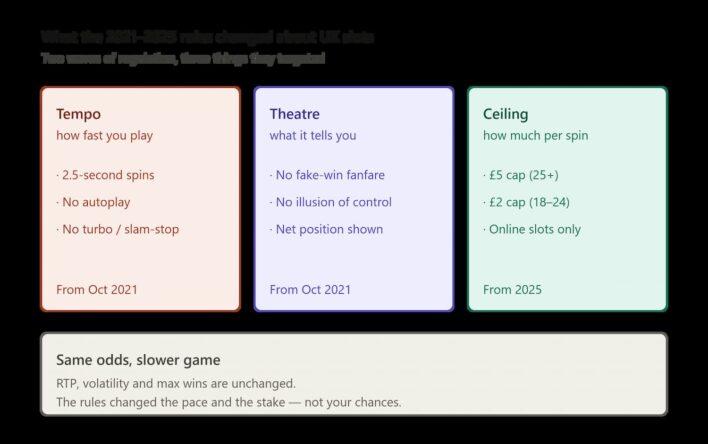
The reforms attack slots on three fronts: the tempo (how fast you can play), the theatre (what the game tells you about winning and control), and the ceiling (how much you can stake). Understand those three and you understand why the games feel the way they do.
First, Why Slots and Not Everything Else
A fair question: why were online slots singled out when roulette, blackjack and sports betting were left largely alone? The Gambling Commission’s own data answers it. Slots carry by far the highest average losses of any online product — the regulator put average monthly spend per slots player at around £67, against roughly £36 for other casino games and £45 for real-event betting. Slots are fast, solitary, continuous and immersive, a combination that drives both the revenue and the harm. That’s why they got the design rules. It’s also, not coincidentally, why they now carry the heaviest tax — the 40% Remote Gaming Duty that made casino bonuses leaner targets the same high-harm product for the same reason.
Tempo: the Game Slowed Down on Purpose
Before October 2021, a UK slot could fly. Turbo and quick-spin modes let the reels resolve in around a second or less, and autoplay would fire off spin after spin while you sat back. At one spin a second, that’s a theoretical 3,600 spins an hour. The faster the loop, the less time to think — and the more you can lose per hour without noticing.
The 2021 game-design code, which became a compulsory licence requirement on 31 October 2021, ended all of it:
A minimum 2.5-second game cycle. After you press spin, you cannot spin again until 2.5 seconds have elapsed — even if the animation finishes sooner. That single rule cuts the maximum spin rate from roughly 3,600 an hour to about 1,440. You can still skip the animation after the result is shown, but you can’t start the next cycle early.
No autoplay. You commit to every single spin by hand. The research that drove this was blunt: a majority of autoplay users said it made them play faster than intended, and around a third said it made it harder to stop. Removing it reinserts a tiny decision before every spin.
No turbo, quick spin or slam stop. Any feature that lets you speed a result to the screen is banned, by whatever name the studio gives it.
No playing multiple slots at once, and no auto-starting the next game cycle.
The effect is a measured, deliberate pace. Some players found it restrictive at first — the muscle memory of hammering the spin button dies hard. But that friction is the point. Every one of those 2.5-second gaps is a moment the regulator wants you to be able to stop in.
Theatre: the Game Stopped Lying to You
This is the subtler wave, and the more interesting one, because it targets psychology rather than mechanics.
Losses disguised as wins are banned. This is the silence you noticed. A “loss disguised as a win” is the old trick of celebrating any return — flashing lights, triumphant sound — even when the amount returned is less than or equal to the amount staked. Stake 50p, get 30p back, and the machine used to throw a small party. You’re down 20p; there is nothing to celebrate. Since the code came in, the sounds and imagery can only fire when you genuinely win more than your stake. The celebration now maps to reality. It sounds minor. It isn’t: that mismatched feedback loop was doing real work on the brain, and removing it strips slots of one of their most effective hooks.
Effects that give the illusion of control are banned. The slam-stop button felt like skill — tap it and you stopped the reels, as if timing mattered. It never did; the random number generator settled the outcome the instant you pressed spin. Banning the feature removes a false sense of agency over a result you can’t influence. Crucially, the rule is careful: it doesn’t touch genuine choices, like a pick-a-box bonus or choosing how many steps to climb in a feature round. Real decisions stay; fake ones go.
Your net position and session time are on screen. UK slots now show you, during play, how much you’re up or down and how long you’ve been at it. No more vague sense that you’re “about even.” The clock and the running total are a built-in reality check — and a quietly powerful one, because the number is hard to argue with.
Reverse withdrawals are gone for good. Separately but in the same spirit, the old ability to request a withdrawal and then cancel it to keep playing — a feature that disproportionately harmed problem gamblers — was banned during the 2020 lockdown and made permanent in 2021. Once you ask to take your money out, it’s coming out.
Ceiling: the Stake Got Capped
The newest wave is the simplest to state and the most visible at the cashier. Until 2025 there was no legal limit on how much you could stake per spin online — high-limit slots happily took £10, £20, even £100 a go. That ended in two steps:
£5 per game cycle for adults aged 25 and over, from 9 April 2025.
£2 per game cycle for adults aged 18 to 24, from 21 May 2025.
A couple of expert details most players missed. The limit is per game cycle, not strictly per spin — it’s the total staked within one cycle, which matters on games that allow multiple stake components before a result settles. And between 9 April and 21 May 2025 the £5 cap applied to everyone, with the lower £2 band for younger adults arriving five weeks later. The caps apply to online slots only — not roulette, blackjack, live casino, scratchcards or bingo, which keep their own limits.
In practice, the lobby looks different. A slot like Mega Moolah, long offered with a bet range up to around £6.25, now tops out at £5 for a player over 25 and £2 for one under 25, because the regulatory ceiling sits above the game’s own options and clips them. The change deliberately mirrors the land-based world, where slot cabinets already carried stake limits, and it leans hardest on younger adults, who the government’s evidence flagged as carrying some of the highest rates of gambling harm.
One earlier change belongs in the same family: since 2019, UK slots have had to strip out the bonus-buy (or “feature-buy”) mechanic — paying a lump sum, often around 100 times your stake, to jump straight into the bonus round. It encouraged exactly the kind of high-velocity, high-stake play the later rules went after.
What the Rules Did Not Change
Here’s where the expert reading matters, because it’s where the casual coverage gets it wrong. None of these rules changed the maths of a slot.
The return-to-player percentage is untouched — a 96% RTP game still returns 96% over the long run. Volatility is untouched; high-variance games still swing wildly. Maximum wins are untouched; a slot advertising a 10,000x top prize can still pay it. Megaways, cluster pays, jackpots, bonus rounds — all still legal, all still here. Genuine in-game choices survived intact.
So what did the rules actually change? The rate and the framing of your exposure, not the odds of it. A capped stake and a slower spin mean you lose money more slowly and see the damage more clearly; they don’t improve your chance on any given spin. The 2.5-second rule doesn’t make the game fairer — the RNG was always fair in the statistical sense — it makes the game slower, which for a continuous, high-loss product is its own kind of protection. Think of it as a redesigned wrapper around an unchanged engine. The house edge is exactly where it was. You just can’t run into it as fast, or be misled about how hard you’re hitting it.
That distinction is the single most useful thing to carry away. A player who believes the rules “made slots safer to win on” has misread them. They made slots safer to play — slower, quieter, honest about losses, and capped — without pretending to change the underlying game of chance.
What This Means When You Sit Down to Play
The cumulative effect is a product that, in the regulator’s intended phrase, feels boring in the best way. The pace is yours to set, one spin at a time. The screen won’t congratulate you for losing. A running total tells you where you actually stand. And the most you can put at risk in one cycle is £5, or £2 if you’re under 25.
For most players, the practical takeaways are small but real. Don’t expect to find £10-a-spin options on any UK-licensed site — if you do, that’s a red flag the operator isn’t properly licensed here. Use the on-screen net-position display rather than your gut; it exists precisely because gut feel runs optimistic. And treat the slower pace as a feature, not a frustration: the gap between spins is the cheapest gambling tool you’ll ever get, and it’s free. For the wider picture of how UK casinos are regulated end to end, our online casinos hub is the place to start.
The redesign isn’t finished — UK gambling rules rarely sit still, and the direction of travel is consistently toward slower, smaller, more transparent play. But the slot you spin in 2026 is a fundamentally different machine from the one of 2020: same odds, very different experience, and engineered that way on purpose.
FAQs About the UK Slot Rules
When did UK online slots change? In two waves. The game-design rules — the 2.5-second spin, autoplay ban and losses-disguised-as-wins ban — became compulsory on 31 October 2021. The stake caps came later: £5 for over-25s from 9 April 2025, and £2 for 18-to-24s from 21 May 2025.
What’s the maximum I can stake on a UK online slot? £5 per game cycle if you’re 25 or over, and £2 per game cycle if you’re 18 to 24. The limit applies to online slots only, not roulette, blackjack, live casino or bingo.
Why is there a 2.5-second gap between spins? To slow the game down. Faster play is linked to higher losses and less considered betting, so since 2021 no UK slot can let you start a new game cycle in under 2.5 seconds — which roughly halves the maximum spins per hour.
Why don’t slots celebrate small wins any more? Because celebrating a return that’s less than or equal to your stake — a “loss disguised as a win” — was banned in 2021. Sounds and winning imagery can now only appear when you actually win more than you staked.
Is autoplay coming back? No. Autoplay is banned on UK slots; you have to commit to each spin manually. The research linked it to playing faster and longer than intended.
Did these rules lower the RTP or my chances of winning? No. Return-to-player percentages, volatility and maximum wins are unchanged. The rules slowed the pace, capped the stake and removed psychological tricks — they didn’t alter the underlying odds.
Do the stake limits apply to all casino games? No — only online slots. Roulette, blackjack, live dealer games, scratchcards and bingo are not covered by the £5/£2 caps.
Can I still play high-volatility slots and big-jackpot games? Yes. Megaways, cluster pays, progressive jackpots and bonus rounds are all still permitted. What’s gone are the speed features, the misleading feedback and the high stakes — not the game types themselves.
What happened to the slam-stop button? It’s banned, along with turbo and quick spin, because it gave a false impression that you could influence an outcome the random number generator had already decided.
Why were slots targeted more than other gambling? Because they carry the highest average losses of any online product and combine speed, immersion and continuous play — the features most associated with harm. That’s also why they carry the highest gaming tax.
18+. Play responsibly. Gambling can be addictive. For free, confidential support visit BeGambleAware.org or call the National Gambling Helpline on 0808 8020 133. This guide is general information; gambling regulations can change, so check the current rules and each operator’s terms before playing.