

If Your Casino Goes Bust, What Happens to Your Balance?
If Your Casino Goes Bust, What Happens to Your Balance?
Say you’ve got £600 sitting in an online casino account — a bit of deposit, some winnings you haven’t cashed out yet. It feels like money in the bank. It’s in an account, it’s got your name on it, the site is UK-licensed. Safe, surely.
Not necessarily. And the gap between what players assume and what’s actually true here is one of the widest in the whole industry. Your casino balance is not like money in a bank. There is no Financial Services Compensation Scheme standing behind it — none of the £85,000 backstop that protects your current account if your bank fails. If a casino goes under, whether you see your £600 again depends entirely on one piece of small print most players have never read: the operator’s fund protection rating.
Here’s the part that surprises people most. UK casinos have no legal duty to protect your money in the event of insolvency. Many choose to, to varying degrees. But the baseline obligation is only to tell you how protected — or unprotected — your money is. This guide explains what the ratings actually mean on the day it matters, why “segregated” is the most misleading word in the cashier, and what a real collapse looks like.
The Word That Does the Deceiving: “Segregated”
Start here, because this single distinction explains almost everything.
Casinos are required to keep customer money separate from the company’s own operating funds. That separation is called segregation, and it sounds reassuring — your money, in its own account, walled off from the business. The trouble is that segregation, on its own, does nothing for you if the company goes bankrupt. Money that’s merely segregated still counts as an asset of the business in insolvency. It goes into the pot, the administrators pay the secured creditors first, and you — the player — join the queue of unsecured creditors near the back, hoping there’s something left.
The Gambling Commission knows this is a trap, which is why it explicitly forbids operators from using the word “protect” when all they’ve actually done is segregate. The two are not the same. Segregated means separate. Protected means ring-fenced so creditors can’t touch it. A casino can be fully, honestly segregated and still leave you with pennies on the pound if it fails. Hold that distinction and the rating system suddenly makes sense.
The Four Ratings, and What Each One Means on the Day It Matters
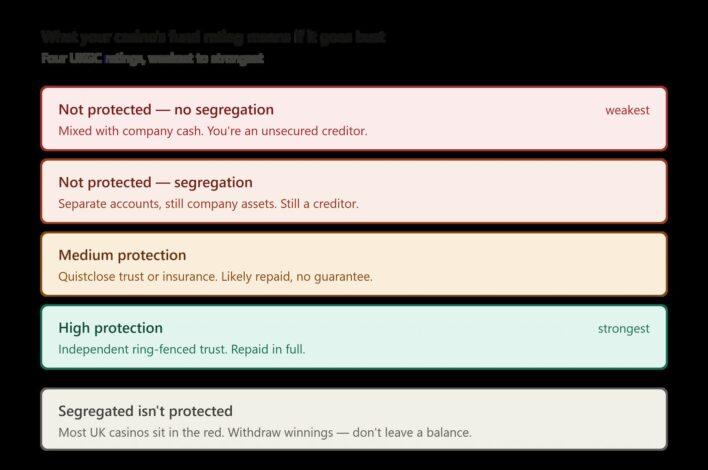
Since a transparency update in October 2025, UK operators must describe their protection using one of four labels. Don’t read them as a gentle scale — read them as four very different outcomes if the worst happens.
Not protected – no segregation. The weakest. Customer money isn’t even kept separate from the company’s operating funds; it’s mixed in. If the operator fails, your balance is indistinguishable from the company’s cash and you’re an unsecured creditor with the slimmest of claims. This is as exposed as it gets.
Not protected – segregation of customer funds. Your money is held in separate accounts — but, as above, those accounts still form part of the business’s assets in insolvency. This is the old “basic” tier, and the label is deliberately blunt now: not protected. It sounds safer than no segregation, and operationally it’s tidier, but on the day the company goes bust the practical outcome is much the same — you’re an unsecured creditor.
Medium protection. A genuine step up. Here the operator uses something like a Quistclose trust arrangement or insurance — a legal mechanism designed to ensure that, if the company fails, the money in customer accounts is distributed back to customers rather than swallowed by creditors. The Commission is careful with its wording, though: there’s “no absolute guarantee” all funds are returned. Better odds of getting your money back, not a cast-iron promise.
High protection. The strongest, and the only one that does what players assume by default. Customer funds sit in a formal, independent trust account that is legally and practically separate from the company, controlled and verified by an independent trustee or external auditor. Because the money is genuinely ring-fenced, it isn’t available to the company’s creditors — so if the operator collapses, the trust pays you back. This is real protection. It’s also, tellingly, the rarest rating.
The hierarchy, then, isn’t “a bit safe, safer, safest.” It’s “you’re a creditor, you’re a creditor, you’ll probably get it back, you’ll get it back.” Two of the four labels contain the words not protected for a reason.
Where to Find Your Casino’s Rating — and the New Reminder
You shouldn’t have to dig, and as of late 2025 you’ll be nudged anyway. Operators must state their protection level in their terms and conditions, disclose it the first time you deposit, and have you actively acknowledge it — a proper tick, not a buried “I agree.” The disclosure has to say what happens to your funds in insolvency, name the rating, and link to the Commission’s own customer-funds page.
The strongest new safeguard arrived on 31 October 2025: any operator with a “not protected” rating must now remind you, once every six months, that your funds aren’t protected — and the reminder has to state the actual amount they’re holding for you. If you get one of those messages, read it as exactly what it is: a regulator-mandated warning that the balance named in the email is money you could lose if the company fails. It’s the cue to withdraw, not to ignore.
To check before you deposit, look in the terms and conditions for a “protection of customer funds” statement, or a security or responsible-gambling section. If you can’t find any mention of it at a site claiming a UK licence, treat that as a red flag in itself.
What Actually Counts as “Your” Money
There’s a further wrinkle that catches people out, and it’s where the most painful losses happen. Not everything in your account is classed as customer funds. Cleared deposits, winnings you’ve chosen to keep, and settled bonuses generally count. But money tied up in an open bet — a wager placed on an event that hasn’t yet settled — is specifically not treated as customer funds, and isn’t covered by whatever protection arrangements the operator has. The same goes for unredeemed betting slips and fees properly charged under the terms.
For a pure casino player this matters less than for a bettor, since slot and table outcomes settle instantly. But it’s the precise mechanism behind the most infamous collapse in recent UK gambling history — and the clearest illustration of how thin “your money” can turn out to be.
What a Collapse Actually Looks Like: Football Index
In March 2021, BetIndex — which ran the betting platform Football Index, marketed as a “football stock market” where customers bought long-running bets on players’ performances — suspended trading and went into administration within hours. Roughly 280,000 customers were affected. The company admitted it didn’t have the money to cover what it owed, with around £124 million tied up in customers’ open bets.
Here’s the cruel detail that ties the whole topic together: because that money sat in open, unsettled bets, it wasn’t protected customer funds. Players could, in principle, reclaim only cash sitting uninvested in their accounts — not the value “invested” in players, which evaporated. Many had treated the platform like a stock portfolio and lost five and six figures. And there was no safety net to catch them: the government declined to compensate gambling losses, and the Gambling Commission has no statutory power to provide redress when an operator collapses. Years on, customers were still waiting to learn how little they’d recover.
Football Index was a betting product, not a casino, and it had its own regulatory failures layered on top. But the underlying lesson generalises perfectly. When a UK gambling operator goes bust, there is no automatic compensation. What you get back depends on whether your money was genuinely protected — and a great deal of it may not have been money the rules even recognised as yours to protect.
What This Means for You: Treat the Account Like a Wallet, Not a Savings Account
You don’t need to become an insolvency lawyer. You need one change of habit and three quick checks.
The habit: stop leaving money in casino accounts. The single most effective protection against an operator collapse is simply not having a balance there when it happens. Treat your account like a wallet you carry cash in for the night, not a savings account you let build up. Won something? Withdraw it rather than letting it sit — and if payouts feel sticky, our fast withdrawal casinos guide explains why approval speed, not payment method, is usually the hold-up. A balance you’ve withdrawn is a balance no administrator can ever touch.
The checks, before you deposit anywhere new:
Find the fund protection rating in the terms. If it’s one of the two “not protected” labels — which is the most common situation across the industry — that’s not a reason never to play there, but it is a reason to keep your balance low and cash out promptly.
Take any six-monthly “not protected” reminder seriously. It’s a regulator telling you, in writing, exactly how much you stand to lose. Act on it.
If you genuinely want to hold a larger balance — for a bankroll, a big win you’re not ready to spend — favour an operator with medium or, ideally, high protection, and accept that high-protection sites are uncommon. For the wider picture of what a UK licence does and doesn’t guarantee, start with our online casinos hub.
The reassuring version of this story would be that a UK licence keeps your balance as safe as a bank deposit. It doesn’t, and pretending otherwise does players no favours. The honest version is more useful: your money is exactly as safe as the rating says it is, the rating is usually “not protected,” and the simplest fix costs you nothing — don’t leave money in an account you don’t need to.
FAQs About Casino Fund Protection
Is my casino balance protected like money in a bank? No. There’s no Financial Services Compensation Scheme equivalent for gambling. Whether you recover your balance if a casino fails depends solely on the operator’s fund protection rating.
What do the protection ratings mean? There are four: “not protected – no segregation,” “not protected – segregation of customer funds,” “medium protection,” and “high protection.” Only medium and high involve arrangements designed to return your money in insolvency; high, via an independent trust, is the strongest.
Does “segregated” mean my money is safe? No — and this is the key trap. Segregated means kept separate from company funds, but segregated money still forms part of the business’s assets in insolvency. Separation is not protection.
Where do I find a casino’s rating? In its terms and conditions, usually under a “protection of customer funds” heading, and disclosed when you first deposit. If a UK-licensed site doesn’t state it anywhere, treat that as a warning sign.
What’s the six-monthly reminder I received? Since 31 October 2025, operators with a “not protected” rating must remind you every six months that your funds aren’t protected, stating the amount they hold. It’s a prompt to withdraw money you don’t need sitting there.
Will I be compensated if my casino goes bust? There’s no automatic compensation. The government has declined to compensate gambling losses, and the Gambling Commission has no power to provide redress for an operator’s collapse. Recovery depends entirely on the protection level.
Are most casinos “high protection”? No. High protection — money in an independently verified trust — is the rarest rating. Most operators sit in one of the “not protected” categories.
What happened with Football Index? The betting platform collapsed in 2021 with around £124 million tied up in customers’ open bets. Because open bets aren’t classed as protected customer funds, and there’s no compensation scheme, many of its roughly 280,000 customers lost most of their money.
How do I protect myself? Don’t leave money in casino accounts. Withdraw winnings promptly, keep balances low at “not protected” sites, and check the rating before depositing. A withdrawn balance can’t be lost to an insolvency.
18+. Play responsibly. Gambling can be addictive. For free, confidential support visit BeGambleAware.org or call the National Gambling Helpline on 0808 8020 133. This guide is general information, not legal or financial advice; operator arrangements and regulations can change, so check each casino’s current terms before depositing.
Written by: Jamie Shaw