

Inside a Live Casino: How the Studio, the Cameras and the Code Actually Work
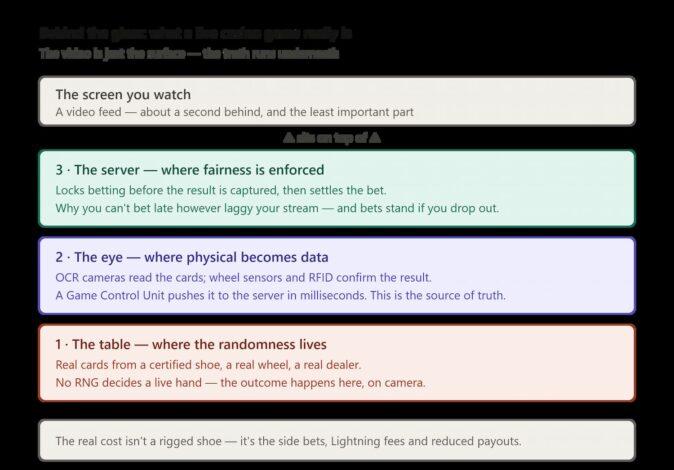
Inside a Live Casino: How the Studio, the Cameras and the Code Actually Work
On your screen it looks like a video call with a croupier. A dealer in a smart waistcoat fans the cards, the wheel clatters, someone says good luck in lightly accented English. Simple.
It is not simple. What you’re watching is a broadcast-grade television studio wired to a database, and the dealer is the least technically interesting thing in the room. Between the moment a card leaves the shoe and the moment it appears on your phone — under a second later, if the operator has spent properly — roughly eight distinct systems fire in sequence. Understanding what they are doesn’t just satisfy curiosity. It tells you why you can’t bet late, why some “live” games are quietly part RNG, where the house edge actually hides, and whether the whole thing is as fair as it looks.
The cleanest way to understand a live game is as three stacked layers behind the glass: the table (where randomness actually happens), the eye (the cameras and software that turn physical events into data), and the server (where bets are locked and outcomes settled). The video you watch sits on top of all three, and — this is the key — it’s the slowest and least important part of the chain.
Layer One: the Table, Where the Randomness Lives
Start with what’s real, because almost all of it is. The cards are physical, drawn from a multi-deck shoe. The roulette ball is a real ball on a real wheel. The dealer is a trained human being. There is no random number generator deciding who wins a live blackjack hand — the randomness comes from the shuffle and the spin, exactly as it would on a casino floor.
That physical randomness is the entire point of the format. Standard online slots and table games lean on a certified RNG, which some players instinctively distrust precisely because they can’t see it — a suspicion we’ve explored in how the UK redesigned online slots. Live casino answers that distrust by putting the randomness on camera. The shoes are loaded with cards shuffled by certified machines or to strict procedure, the wheels are engineered and maintained to tolerances, and every physical step is designed to be both genuinely random and visibly so.
Keep this layer in mind, because it’s the answer to half the “is it rigged?” anxiety later: the outcome is generated by hardware, in view, before any software gets involved.
Layer Two: the Eye, Where Physical Becomes Data
Here’s the clever part, and the part nobody sees. The casino’s software has to know — instantly and perfectly — that the dealer just turned a queen of hearts. It can’t ask the dealer to type it in; that would be slow and fallible. So the table reads itself.
The core technology is optical character recognition. High-definition cameras trained on the table feed video to OCR software that recognises the rank and suit of every card the instant it’s exposed, and converts it to data in milliseconds. Roulette adds a second source: sensors built into the wheel track the ball and identify the winning pocket independently of the camera, so the result is confirmed two ways. Where the equipment supports it, cards and shoes carry RFID tags, and the OCR reading is cross-checked against the RFID signature — a belt-and-braces verification that the digital result matches the physical one.
Tying it together at every table is a Game Control Unit, a small box that encodes the video broadcast and shuttles the OCR and sensor data to the platform. The GCU is the table’s nervous system; no GCU, no live game.
Now the crucial conceptual point. The data layer, not the video, is the source of truth. When you “see” your win, what actually happened is that OCR read the card, the GCU pushed the result to the server, the server settled your bet, and then the interface showed you — often laid over a video feed that is, by design, a beat behind. The picture is a representation. The data is the fact.
Layer Three: the Server, Where Fairness Is Enforced
This is where the format quietly solves a problem that worries thoughtful players: if the video has a delay, couldn’t someone bet after seeing the result?
No — and the reason is that betting windows are controlled by the server, not by your stream. End-to-end latency in a good live casino is under a second: the studio encodes and ships the feed to a content-delivery network, your device decodes and renders it, and the combined lag on a stable connection feels close to real-time. Lower-tier operators run several seconds behind. But however long the video takes to reach you, the server closes betting before the wheel result or the next card is captured. Past-posting — betting late on a known outcome — is impossible, because the moment betting is locked is set server-side, upstream of the picture you’re watching. Your lag can never be the house’s loss, or your gain.
The same architecture handles disasters gracefully. Lose your connection mid-hand and any bet you’ve already placed stands and is settled on the physical result; you simply rejoin to see what happened. The game ran on the server and the table, not on your phone.
The Studio: a TV Production That Never Stops
Step back and the scale becomes obvious. These games aren’t filmed in a back room. The market leader, Evolution — founded in 2006 and now the dominant force after absorbing NetEnt and others — runs vast, purpose-built studios in Riga, Malta, Tbilisi, the United States, Canada, Colombia and beyond, broadcasting 24 hours a day. Riga is the flagship: a floor of dozens of tables, hundreds of cameras, lighting rigs, vision mixers and a control room that would be familiar to anyone who’s worked in television.
The dealers are broadcast staff as much as croupiers, trained to studio standards, rotated off tables at intervals to stay sharp, and overseen by pit bosses watching for procedural slips. Every dealer action is logged — typically via a smart card they use at the table — so any disputed round can be reconstructed. Many studios run native-language tables, with dealers presenting in the player’s own language during peak local hours. It is, in the most literal sense, a casino crossed with a TV network, running every minute of every day.
Why You Get Unlimited Seats and Low Limits
One innovation reshaped the economics of the whole category, and it’s worth understanding because it explains both the low minimum bets and the fact you never wait for a chair.
A real blackjack table seats seven. Evolution’s classic tables preserve that, and add Bet Behind — letting any number of players wager on a seated player’s hand without sitting down themselves. But the bigger leap is the Infinite family — Infinite Blackjack, Power Blackjack, Free Bet Blackjack — which seats an unlimited number of players at one table using a common-card model. Everyone is dealt the same initial two-card hand, then each player decides independently how to play it: hit, stand, double, split. One dealer, one shoe, one opening hand, thousands of simultaneous players each making their own choices.
That’s why live casino can offer minimums as low as 50p or £1 with no queue — a single table monetises a near-limitless crowd, so the operator doesn’t need a high floor to make it worthwhile. Speed variants trim the pace further, resolving a baccarat hand in under half a minute. There’s usually a decision timer of around fifteen seconds, with a sensible default applied if you don’t act — stand on a strong hand, hit on a weak one — so one slow player can’t stall thousands.
The Hybrid Games: Where “Live” Quietly Meets RNG
Here’s a distinction most coverage skips, and it matters for your money. Some of the most popular “live” games are hybrids — a physical core with an RNG bolted on — and the glamorous bit is the RNG bit.
Take Lightning Roulette. The wheel spin is entirely physical. But before each spin, software randomly selects one to five “Lucky Numbers” and assigns them multipliers of up to 500x. Those multipliers are RNG-generated, certified separately, and — crucially — they aren’t free. Straight-up numbers in Lightning Roulette pay 29:1 instead of the standard 35:1; the reduced base payout is precisely what funds the headline multipliers. Lightning Blackjack is the same idea with an explicit twist: you pay a “Lightning fee” on every bet in exchange for a guaranteed multiplier on a winning hand. The game shows Evolution pioneered — Crazy Time, Monopoly Live, Dream Catcher — go further still, wrapping a physical money wheel in RNG bonus rounds and multipliers that can run to thousands of times your stake.
None of this is hidden or improper; it’s all disclosed and independently tested. But the expert read is simple: in these games you are buying volatility. The multipliers are thrilling and occasionally enormous, and you pay for the privilege through worse base odds or an added fee. The same logic applies to the side bets on every live table — Perfect Pairs, 21+3, Bust It and the rest. Infinite Blackjack’s main game runs a very high theoretical return; bolt on the Bust It side bet and the return on that wager drops sharply. The side bets and the lightning are where the value leaks out.
At the far end sits Evolution’s First Person range — fully RNG versions of the live games, same rules and paytables, with a “Go Live” button to jump to a real table. The line between live and RNG isn’t a wall. It’s a slider, and the hybrid games sit in the middle.
“Is It Rigged?” — the Honest Answer
Search for long enough and you’ll find players convinced live blackjack is fixed: impossible dealer streaks, too many five-card 21s, the sense that the shoe is stacked against them. The suspicion is understandable. It’s also, on the mechanics, misplaced — and it’s worth explaining why rather than just asserting it.
First, the house doesn’t need to cheat. The edge in every casino game is mathematical and permanent; over enough hands the rules alone guarantee the operator’s margin. Rigging would add risk for no reward. Second, live outcomes are physical and watched: real cards from a certified shoe, a real wheel, a dealer on camera, a pit boss supervising, every action logged, and the random elements — shuffles, spins, wheel segments — audited by independent laboratories such as GLI and eCOGRA as a condition of the operator’s UK Gambling Commission licence. The RNG components in the hybrid games are certified by those same labs. Manipulating outcomes live, across thousands of simultaneous players, under that level of scrutiny, would be both pointless and extraordinarily hard to hide.
So what produces the “it felt rigged” experience? Variance and memory. A genuinely random shoe produces streaks — long ones — and the human brain is a pattern-finding machine that remembers the six-card dealer 21 and forgets the hundred unremarkable hands around it. Add the house edge grinding quietly in the background and a losing session feels engineered when it’s merely typical. The real, provable disadvantage isn’t a fixed deck. It’s the stuff hiding in plain sight: the side bets, the lightning fees, the 29:1 payouts — the costs you can choose not to pay.
What This Means When You Sit Down
A few practical takeaways fall straight out of the mechanics.
Trust the result, not your lag. The outcome is settled server-side on a physical event; your slightly delayed video can’t cheat you and can’t help you. If a stream stutters, the data layer still has the truth.
Mind where the value leaks. The base games — straight blackjack, European roulette, baccarat — carry the format’s best returns. The side bets, Lightning fees and game-show multipliers are entertainment you pay a premium for. Enjoy them with open eyes, not as a strategy.
Check the bonus rules before you play live. Live dealer games typically contribute far less to wagering requirements than slots — often 10% or nothing at all — so clearing a bonus at the live tables can be slow or impossible. Our casino bonuses guide covers how contribution weighting works.
And stick to UK-licensed operators, where the studio, the shuffle and the RNG components are all certified and audited. For the wider picture of what that licence guarantees, start with our online casinos hub. And if you want to know where to actually play, our pick of the best UK casinos for live dealer games ranks them by table depth and providers.
The magic trick of a live casino is making something enormously complex feel like a casual video call. Knowing what’s behind the glass doesn’t spoil it — it just means you understand exactly what you’re betting into, and where the game is quietly charging you for the spectacle.
FAQs About Live Dealer Casinos
Are live casino games real or computer-generated? The core outcomes are real and physical — actual cards from a shoe, a real roulette wheel, a human dealer. Cameras and OCR software simply convert those physical events into data for your screen. There’s no RNG deciding live blackjack or roulette results.
How does the casino know what card was dealt? Optical character recognition reads the cards from high-definition cameras in milliseconds, roulette wheels add built-in sensors that detect the winning pocket, and where present, RFID tags cross-check the reading. A Game Control Unit at each table relays it all to the server.
Can I bet after seeing the result because of the video delay? No. Betting is locked by the server before the outcome is captured, regardless of how far behind your video stream runs. Past-posting is impossible by design.
What happens if I lose connection mid-hand? Any bet already placed stands and is settled on the physical result. The game runs on the server and the table, not your device, so you just rejoin to see the outcome.
How can a live blackjack table have unlimited seats? Games in the Infinite family deal every player the same common opening hand, then let each person play it independently. One dealer and one shoe can serve thousands of players at once, which is also why minimum bets can be so low.
Are Lightning Roulette and Crazy Time fully live? They’re hybrids. The wheel or money-wheel spin is physical, but the multipliers are RNG-generated and certified separately. You pay for those multipliers through reduced base payouts or an added fee.
Is live dealer blackjack rigged? No. Outcomes are physical, on camera, supervised, logged, and audited by independent labs such as GLI and eCOGRA as a UKGC licence condition. The house edge is mathematical, so rigging would be pointless. Losing streaks are normal variance, not manipulation.
Where’s the real house edge in live games? In the rules and the extras. Base games carry the best returns; the side bets, Lightning fees and game-show multipliers all lower your effective value in exchange for bigger possible wins.
Do live games count towards casino bonus wagering? Usually only partially — often 10% or not at all — so check the bonus terms before trying to clear a wagering requirement at the live tables.
Who runs most UK live casino tables? Evolution is the dominant provider, streaming from large studios in Riga, Malta, Tbilisi and elsewhere, with Playtech and Pragmatic Play among the other major operators. Most UK casinos license their live games from these specialists rather than running their own.
18+. Play responsibly. Gambling can be addictive. For free, confidential support visit BeGambleAware.org or call the National Gambling Helpline on 0808 8020 133. This guide is general information; game features and providers can change, so check each operator’s current details before playing.
Written by: Jamie Shaw