
The 40% Gaming Tax and Why Your Bonuses Got Leaner
Remember when “100% up to £500 plus 200 wager-free spins” was a normal welcome offer? It isn’t any more. The headline numbers have shrunk, the wagering terms have crept up, the genuinely wager-free deals have thinned out, and the max-cashout caps that quietly limit what you can actually win from a bonus have tightened. Players notice. Most assume the casinos simply got greedier.
They didn’t. On 1 April 2026 the UK doubled the tax on online casino play, and you are now paying most of it — not at the cashier, but in the value that’s been stripped out of every offer. This is the operator-economics story behind the trend, and once you understand how the money actually flows, you’ll never read a welcome bonus the same way again.
What Actually Changed
Remote Gaming Duty — the tax on online slots, casino and similar products — jumped from 21% to 40% on 1 April 2026. Not a tweak. A near-doubling of the duty bill overnight, and the steepest single increase the sector has faced in a decade.
A few details matter enormously for what follows. First, the duty is charged on gross gaming yield — player stakes minus winnings paid out, i.e. the operator’s gross win — not on turnover. So 40% isn’t 40% of what you wager; it’s 40% of what the house keeps. Second, it’s levied by customer location, so an operator based in Malta or Gibraltar still pays UK duty on UK players. Third, the government targeted gaming deliberately and unequally: bingo duty (formerly 10%) was abolished outright, and online sports betting faces a lesser 25% rate from April 2027, with bets on UK horse racing left untouched at 15%. The logic, stated plainly in the Budget, is that casino-style gaming is considered the most harmful and the lowest-cost product, so it should carry the heaviest tax.
The announcement itself was chaos. An Office for Budget Responsibility document leaked before the Chancellor stood up, and gambling shares fell sharply before the speech even began; the 40% figure landed well above the 30–35% most of the City had braced for, with some think tanks having pushed for 50%. Operators spent that afternoon cutting profit forecasts and warning about job losses. That reaction tells you something: 19 extra percentage points of duty is not a number a business absorbs quietly.
Follow the Pound: Where £100 of Gross Win Goes Now
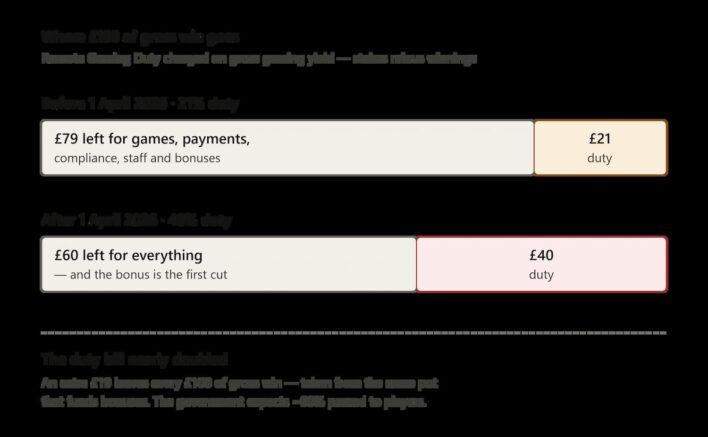
Here’s the bit nobody explains to players. Let’s trace £100 of gross gaming yield — £100 that players, collectively, have lost on a casino — through the operator’s books, before and after April 2026.
Before: £21 to Remote Gaming Duty, leaving £79.
After: £40 to Remote Gaming Duty, leaving £60.
That £19 didn’t come out of thin air. It came out of the same £100 that also has to pay for everything else: the statutory levy (up to a further 1.1% of gross yield, in force since 2025); game-content royalties, where premium slot studios take a meaningful slice of every spin; payment processing; platform and aggregator fees; the genuinely expensive machinery of KYC, anti-money-laundering and the affordability checks that ballooned across 2025; customer support; staff; and — the elastic one — marketing and bonuses.
Run the arithmetic and the duty line alone now swallows two-fifths of gross win before a single one of those costs is met. On a product whose net margin after content and overheads was already thin, removing an extra £19 from every £100 is the difference between an offer the operator can afford and one it can’t. The tax didn’t just rise. It moved from “a cost of doing business” to “the largest single claim on the margin,” and something else on that list has to give.
Why the Bonus Is the Shock Absorber
When tax eats the margin, an operator has exactly three levers to pull. Think of them as payout, promo, product.
Payout means the return-to-player percentage baked into the games — quietly serving a 94% version of a slot instead of a 96% one widens gross yield, though UK transparency rules make this visible to anyone who checks the game info screen.
Product means the mix — leaning into sports betting (taxed at 25%, not 40%) and away from casino-only exposure, or diversifying into verticals the duty hits less hard.
Promo means the bonuses, the free spins, the reloads, the VIP perks — your value.
Of the three, promo is the shock absorber. Payout changes are slow, regulated and reputationally risky. Product changes take years and a different licence mix. But the bonus budget? It can be re-cut next week, it’s invisible to anyone not comparing offers month to month, and it’s the line every finance director reaches for first when margin tightens. So when the duty doubled, the bonus is what moved — fastest and hardest.
The Pincer: a 40% Duty Meets a 10x Wagering Cap
This is the part that separates what’s really happening from the lazy “casinos got mean” take, and it’s the single most important thing to understand about why offers shrank rather than just got stingier on the headline.
Bonuses were never free for the operator, but they used to be recoverable. A casino could dangle a fat £50 bonus at 65x wagering and claw most of it back through the sheer volume of required play — 65 times £50 is £3,250 of turnover, and the house edge grinds a return out of every spin of it. High wagering was the mechanism that made big headline bonuses affordable.
Then, in January 2026 — months before the duty rise — the Gambling Commission capped bonus wagering at 10x. Suddenly that same £50 bonus could only demand £500 of turnover, not £3,250. The recovery lever was cut by more than 80%. The bonus got far more expensive to honour overnight.
Now stack April’s 40% duty on top. The operator faces a pincer: it can no longer make a big bonus cheaper through high wagering (capped), and it has less post-duty margin to fund the giveaway in the first place (the tax). Two levers gone, one direction left. It can’t make the bonus cheaper to clear, so it makes the bonus smaller, rarer and more conditional. “Up to £500” becomes “up to £50.” Two hundred wager-free spins become fifty. The reload that used to land every Friday now comes monthly, if at all. None of that is spite. It’s two regulations colliding, and the bonus sitting at the crash point.
What This Looks Like From Your Seat
Translate the economics into what you actually see when you open a cashier in 2026:
Smaller headline matches and lower caps. The £500 and £1,000 welcome matches are increasingly £25–£100, because the operator can no longer dilute the cost across high wagering.
Wager-free offers becoming a premium, not a default. A genuinely wager-free bonus is the most expensive kind to give — real, withdrawable money with no playthrough to recover the house edge. Those are exactly the offers a squeezed margin kills first, which is why the ones that survive are worth disproportionately more. Our best casino bonuses guide ranks by usability for this reason.
Tighter max-cashout caps. Watch the small print on free-spin offers: a £50 or £100 win cap is the quiet way to limit a bonus’s downside, and it’s tightened as margins thinned.
Leaner VIP and reload programmes. Ongoing generosity — the cashback, the reloads, the loyalty perks — is funded from the same shrinking margin, so it’s been trimmed alongside the welcome offer.
More cross-selling into sports. Because sports betting is taxed at 25% rather than 40%, expect more nudges toward the sportsbook — though note the January 2026 ban on mixed-product offers means a casino can no longer make you bet on football to unlock slots spins.
Who Got Hit Hardest — and Why the Big Brands Still Look Generous
The duty’s differential — 40% on gaming, 25% on betting, 15% on horse racing — quietly reshaped which casinos can still afford to be generous.
A multi-vertical giant that runs a sportsbook, a casino and more can cushion the casino’s 40% hit with lower-taxed betting revenue and sheer scale. The familiar household names have that cushion. A casino-only independent — including many of the smaller sites running on shared white-label platforms — has no such buffer. Every pound of its revenue takes the full 40%, which is why the leanest offers, and some outright market exits, have clustered among the single-vertical specialists. The era of the casino-only brand competing on bonus size is effectively over; the Budget made diversification a survival requirement, not a strategy.
For operators built to last through this squeeze, see the independent casinos that run their own platform.
There’s a darker edge the operators themselves keep raising: the black market. Entain’s chair warned that an ordinary punter often can’t tell a regulated site from a slick illegal one — and unlicensed operators pay no UK duty, run no affordability checks, and return nothing to the Treasury. The OBR’s own forecast assumes the duty rise will shrink the legal market’s yield by roughly a third as demand falls and some play migrates. Leaner regulated bonuses, in other words, carry a regulatory risk of their own: they make the unprotected alternatives look comparatively attractive, which is precisely the wrong outcome. The value to you of a UK-licensed site was never only the bonus — it’s the withdrawal protections, source-of-funds rigour and dispute rights that the offshore version strips out.
The Honest Bottom Line: You’re Paying It
Remote Gaming Duty is a tax on operators. But the government’s own modelling assumes operators pass on around 90% of the increase to consumers — through reduced payouts and worse value, not a line item you’ll ever see. That is the mechanism in one sentence: a tax levied on the casino, paid by the player, collected in the currency of leaner bonuses.
Knowing that changes how you should shop. The point isn’t to mourn the £500 wager-free era; it’s to recognise that headline size has become an even worse guide to value than it already was, and that the real differences between offers now hide in the terms.
How to Spot Genuine Value in a Leaner Market
The squeeze rewards players who read past the headline. A practical lens for 2026:
Weigh the wagering base, not just the multiple. With wagering capped at 10x, the multiple matters less than what it applies to — “10x bonus” is far gentler than “10x deposit plus bonus.” The base is where the real cost hides.
Hunt the max-cashout cap first. A “200 free spins” offer with a £50 win cap is a £50 offer. Find the cap before the spin count impresses you.
Treat surviving wager-free offers as the premium tier. They’re the ones the maths should have killed, so the operators still running them are spending real money to compete — that’s genuine value, not marketing.
Favour low-wagering over big-headline. A £25 bonus at low or no wagering routinely beats a £200 bonus you can’t realistically clear within the expiry — and the post-cap market has more of the former than it used to.
Check the payout side too. A leaner bonus at a casino that pays fast and cleanly beats a fatter one stuck behind slow approvals; our fast withdrawal casinos guide covers why approval speed, not payment method, is the real clock.
The generous era didn’t end because casinos changed their character. It ended because the arithmetic changed underneath them — and the operators that still offer real value in 2026 are the ones worth your attention, precisely because the tax made it harder to.
FAQs About the Gaming Tax and Casino Bonuses
What is Remote Gaming Duty? It’s the UK tax on online casino, slots and similar gaming products. It’s charged on gross gaming yield — players’ stakes minus their winnings — and it rose from 21% to 40% on 1 April 2026.
Why did my casino bonuses get smaller in 2026? Two changes collided. January 2026 capped bonus wagering at 10x, removing the operator’s main way to recover a bonus’s cost; April 2026 doubled the gaming tax, shrinking the margin bonuses are funded from. With both levers gone, operators cut bonus size rather than terms.
Is the 40% tax paid by me or the casino? Legally, the casino. In practice, the government expects operators to pass on around 90% of the increase to players through reduced payouts and leaner offers — so you pay most of it indirectly.
Are sports bets taxed the same as casino games? No. Online sports betting faces a 25% rate from April 2027, and bets on UK horse racing stay at 15%. Casino gaming carries the highest rate at 40%, which is why casino bonuses were hit harder than free bets.
Will bonuses keep getting worse? The structural pressure is downward, but value now lives in the terms, not the headline. Wager-free and low-wagering offers still exist and are worth disproportionately more in a leaner market.
Does the tax affect the games’ RTP? It can create pressure to serve lower-RTP versions of slots to widen margin, but UK rules require RTP to be visible on the game info screen, so you can always check before you play.
Why are smaller casino-only sites offering less than the big brands? Multi-vertical operators can offset the 40% gaming duty with lower-taxed sports revenue and scale. Casino-only independents take the full hit on every pound, so their offers thinned fastest — and some left the market entirely.
Is it still worth playing at UK-licensed casinos if the bonuses are leaner? Yes. The licence buys you withdrawal protections, source-of-funds and affordability safeguards, and free dispute resolution — none of which exist at the unlicensed offshore sites whose “bigger” bonuses come with no consumer protection at all.
18+. Play responsibly. Gambling can be addictive. For free, confidential support visit BeGambleAware.org or call the National Gambling Helpline on 0808 8020 133. This guide is general information, not financial advice; tax rates, regulations and operator offers can change, so check current terms before depositing.
Written by: Jamie Shaw